June 2nd, 2010: The Brunel Museum in Rotherhithe has won a Queen's Award for Voluntary Service - seemingly the 'MBE for Volunteer Groups'.
A short and slightly misleading piece in the South London Press (a mere 2 column inches) was how I discovered this.
But anyway - Well done! Well deserved!
(I also note that the Web site has improved a lot since I mentioned it last year)
Showing posts with label tunnel. Show all posts
Showing posts with label tunnel. Show all posts
Wednesday, 9 June 2010


Sunday, 15 November 2009
Spain Tour 10: Tunnel to Bulnes
Pobcebos and Bulnes aren’t really that far from Potes, but there are mountains in the way. So we had to drive North (back through the Gorge again), then West, then South to get there.
The chief reason for including this picture, taken in the Gorge, is as a reminder of the speedy, scary Spanish drivers up in those parts, and their careful lane discipline...
 ... and here I managed to catch a picture of the two cars passing at the mid-point - where the single track railway suddenly blossoms into a passing place.
 However, given that two members of the household took the trouble to climb up the hard way, it seems only reasonable to end with a few of their photographs:




The chief reason for including this picture, taken in the Gorge, is as a reminder of the speedy, scary Spanish drivers up in those parts, and their careful lane discipline...
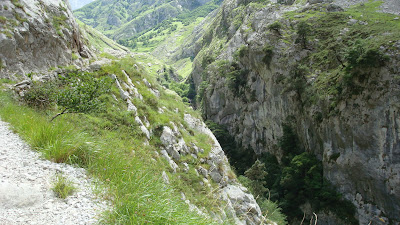
 Finally we reached the southern leg of the journey, along the A264 (Carretara de Poncebos), through the Cares gorge. If anything, these mountains seemed even more stark and rugged than the ones we had left in the Eastern Picos.

 At Poncebos is the entrance to a most unlikely construction. The Funicular de Bulnes. Bulnes is the only town in Asturias - apparently- with no road access. So before 2001 the only way to reach it from Poncebos was to take the steep, narrow, winding track by foot or donkey.
However, with significant EU funding the mindbending decision had been made to bore a tunnel 2.23 km long, rising around 400m, to carry a small funicular railway between one and the other. The journey takes 7 minutes, the inclination is 18%, the car takes up to 28 passengers, there is a van for goods as well (if wanted) - it really is a marvel. And the residents of Bulnes go for free.
But what astonishes me is that it was built at all. The decision wasn't uncontroversial, and from the OJEC records, there seem to have been some serious questions:
Work has begun on the funicular railway which will provide access to Bulnes, despite the fact that appeals havebeen lodged and that the work has not even been approved (as is legally required) by those responsible forrunning the national park. This irregularity was pointed out by the Environment Ministry in a document of6 November which was signed by the head of the national parks division and which points out to the AsturiasRegional Government that there are irregularities in the project.
In specific terms, three irregularities are mentioned:
− The works project should have been the subject of a prior report by the park management.
− The plan (PLAN) made available for public consultation does not correspond to the one ultimately put intoeffect by the body promoting the funicular railway.
− The lack of legal backing for the project in its attempts to circumvent what is laid down in the Picos deEuropa natural resources plan.
Many environmental bodies which have appealed against the Bulnes funicular railway maintain that thedocument from the Environment Ministry justifies their claims.(Written Question to the Commission at OJEC (98/C 323/71) - answered on the following page)
Well, it's there now - surreal as that may be - so the youngest and I decided to have a go.
 Its long, very long, and seems incredibly steep. Some of the effects from inside the car are quite spectacular.


 At the top, after leaving the funicular, you seem deep in the mountains. A path leads away along reasonably level ground to the pueblo of Bulnes.


 We stopped at Bulnes for a snack. The village is very touristy, with lots of cafes and places to take refreshment. While we were there it seemed crowded, but that may just be because a group of teenage International Scouts had stopped a little way outside the village - and they seemed to be everywhere. Large numbers of walkers and climbers also come to this part of the Picos.
While we were there we finally witnessed and heard the harsh sounds of the Asturian bagpipes.  I really enjoyed them - youngest was less sure. (Actually he was very sure - he said he thought they were horrid).
We waited a while, wandering around the village, and then finally met up with the others who had come up by the donkey-path. They certainly looked as if they'd had sufficient exercise!
This is the upper entrance to the funicular. We all took the railway down... ... and here I managed to catch a picture of the two cars passing at the mid-point - where the single track railway suddenly blossoms into a passing place.
 However, given that two members of the household took the trouble to climb up the hard way, it seems only reasonable to end with a few of their photographs:


Saturday, 24 October 2009
Small and Perfectly Formed
During the week we went to the Brunel Museum in Rotherhithe. This must be one of the very smallest Museums in London. Set in the building that used to house the steam engine that pumped water from the foot tunnel that Marc Brunel and his son - Isambard Kingdom - dug under the Thames between 1825 and 1843.
This was the first tunnel successfully bored under a navigable river, and was a wonder of the age.

 The Mayflower pub is built close to the landing steps from which the Pilgrim Fathers set sail for America, and is a well-known old pub with terrific views over the river from its own jetty. I haven't had a pint there in years, but have very fond memories...
 There has been a lot of gentrification around about here, with wharves and warehouses converted to house yuppy flats and 'creative' industries, but although it feels a bit twee it hasn't been badly done.
 This tiny little area is very close to the Rotherhithe (road) tunnel - which is horrible. But the chief attraction for those who live there is, I guess, its nearness to the centre.
 Finally, we stepped out briefly and surveyed the river under which Brunel's tunnel still travels. 1200 feet wide at this point, it very hard to grasp what runs underneath...


This was the first tunnel successfully bored under a navigable river, and was a wonder of the age.

The Wikipedia article on the Tunnel is quite comprehensive. The tunnel never did service the horse traffice it was intended for - the ramps at either end were never built. Foot traffic reached the tunnel through vertical shafts (you can just see the top of one painted blue to the far left of the picture above). The tunnel is till used to carry the East London Line of the tube network under the river. It is thus, as a panel in the Museum says, 'The oldest section of tunnel on the oldest underground railway in the World'.
What Wikipedia doesn't tell you is how small the Brunel Museum is. An upper floor has some lively panels explaining the tunnel project and what happened in the end, with a few objects (eg a note book, some engineering drawings). Below this is a small multimedia area (about 15 seats, a telly and a dvd player), and schools/children's activity space. A mezzanine level houses the entrance, gift shop and cafe in a space about ten yards by eight.

As for staff, he was sitting outside having a fag when we arrived. He meeted and greeted us, sold us tickets, told us the best away around the place so we didn't get confused, started the multimedia display up when we said we were interested in the film, and offered us merchandise from the gift shop. He didn't seem busy - in the 60 minutes we spent on the visit we were the only people there.
(And for the record, its Web site consists of just one page)
And yet it was really very intersting, and was a good visit. Being just on one subject, and with just one gallery, and a small one, you end up paying really close attention to everything there is. You focus, and miss nothing. The displays and panels are very good, and the story the Museum tells is extremely interesting (at least I thought so) - and a World first.
There is a planned development which would make use of the shaft down to the Tunnel for further displays and so forth, but they are still fundraising. I also gather that every so often (once a year?), pre-booked visitors can go down the shaft and explore the Tunnel (the trains are switched off on those days!)
So go, but, please, not all at once.
All around the Museum the street names reflect the tunnel and the Brunels, and it is set in an area of historic Rotherhithe.

 The Mayflower pub is built close to the landing steps from which the Pilgrim Fathers set sail for America, and is a well-known old pub with terrific views over the river from its own jetty. I haven't had a pint there in years, but have very fond memories...
 There has been a lot of gentrification around about here, with wharves and warehouses converted to house yuppy flats and 'creative' industries, but although it feels a bit twee it hasn't been badly done.
 This tiny little area is very close to the Rotherhithe (road) tunnel - which is horrible. But the chief attraction for those who live there is, I guess, its nearness to the centre.
 Finally, we stepped out briefly and surveyed the river under which Brunel's tunnel still travels. 1200 feet wide at this point, it very hard to grasp what runs underneath...


Subscribe to:
Posts (Atom)