Showing posts with label Paris. Show all posts

Wednesday, 25 March 2020

The Man Who Was Thursday

Now that we are all in (semi-) lockdown, I'm taking the opportunity to read some, at least, of my pile of unread books.  It's a bit on the towering side.

I'll post commentaries here and on Mens Sana (Facebook Group).

Here's the first one.

Mere Anarchy

G. K. Chesterton, The Man Who Was Thursday: A Nightmare, (1908), (Penguin Edition, with ‘Introduction’ by Matthew Beaumont, 2011).

My, but this is an odd book. 

When I chose it from the pile of unread books, I thought I was picking a simple tale of derring-do, a ripping yarn rather akin to The Riddle of the Sands (Childers, 1903) or The Thirty-Nine Steps (Buchan, 1915), albeit hopefully leavened with Chesterton’s characteristic wit.   I knew it was about secret anarchists and plots, bombings and detectives, but that was about all I knew.  And around this time, there was a lot of fiction, and nonfiction concerning anarchists being written.

The Spirit of Revolt (Kropotkin, 1880), The Dynamiter (Stevenson, 1885), The Science of Revolutionary Warfare: A Little Handbook of Instruction in the Use and Preparation of Nitroglycerine, Gun-Cotton, Fulminating Mercury, Bombs, Fuses, Potions, Etc, Etc (Most, 1885), The League of Twelve (Boothby, 1903), A Girl Among the Anarchists (Olivia and Helen Rossetti, 1903) and  The Secret Agent (Conrad, 1907) are all mentioned in the critical apparatus in the book. 

Nobel had patented dynamite in 1866 (first demonstrated in Redhill) and gelignite in 1876.  In 1893, the Chamber of Deputies in Paris was bombed; in 1894 there was an unsuccessful bomb attack on the Royal Observatory in Greenwich, and separately the French President was assassinated; in 1897 the Spanish prime minister was assassinated; in 1900 the King of Italy was assassinated; in 1906 there was a failed attempt to bomb the King of Spain;  and in the month Chesterton’s book was published the King of Portugal and his son were assassinated.  Bombs, revolutions, assassinations and anarchists were on everyone’s minds.

And there is a plot, a story which revolves around all of this material, as a detective/poet attempts to thwart an anarchist plot to bomb the Czar and the President of France, in Paris.  It is a plot concerning the fight between order and anarchy, as conducted by a brave individual.  But it is such an extreme, madcap, ridiculous plot that you end up coming to the conclusion that it isn’t really the point. 
Partly this is because it is written by Chesterton.  As such, the book is full of witty observations, paradoxes and inversions. 

“All the same,” replied Syme patiently, “just at present you only see the tree by the light of the lamp.  I wonder when you would ever see the lamp by the light of the tree.” (p.8).

The paradoxes are even there in some of the chapter titles (11: ‘The Criminals Chase the Police’).  And while some of the observations feel hopelessly dated, many still seem quite fresh over a century later interesting – such as when he speaks of the uncanny feeling one gets at a waxworks (p.39) – an early example of the ‘Uncanny Valley’?  

Chesterton is also very good on small details and the quotidian.  He wants to describe everything, even the most mundane item.    He cares about the wonderfulness of the everyday, the banal ordinary.  As when the hero is inspired to courage by the sound of a simple, common barrel organ in Leicester Square.

At the same time, his abiding interest in the grotesque is ever-present.  Every one of the anarchists has odd, weird traits, unlikely facial expressions and tics.  None just look normal or unremarkable. 
So, in one sense this novel is Chesterton’s version of Browning’s dramatic monologues (see Men and Women (1855), Dramatis Personae (1864) and many other individual poems).  And of course, he had written his excellent book on the poet in 1903, praising his grotesqueries and his interest in the quotidian, while arguing that these were also routes to the spiritual (I paraphrase). 

Amongst the grotesques the huge figure of the President of the anarchists stands out.  And as Chesterton himself was a large man, one begins by assuming that this is a self-portrait.  After all the President sets much of the plot in action and is feared by all the others; an obvious author-substitute.  However, by the end one realises this is probably not the case.  Or not just the case.

Because the end is quite unexpected.  If the story is so extreme and the characters so unlikely, that they undermine the whole notion of the adventure-narrative, and also play against Chesterton’s fine details and interest in the ordinary, which I would contend they do, then the conclusion of the novel takes another yet turn to the unexpected.

It goes all mythic and transcendent.  Arguably this may have been the only place left for Chesterton’s madcap narrative to go, but it still comes as a surprise.  Without saying too much, it goes supernatural and religious, and there are some interesting proto-surrealist touches.

…a vast carnival of people were dancing in motley dress.  Syme seemed to see every shape in Nature imitated in some crazy costume.  There was a man dressed as a windmill with enormous sails, a man dressed as an elephant, a man dressed as a balloon… one dancer dressed like an enormous hornbill, with a beak twice as big as itself…
                                                                                                                                    (p.152)

For Chesterton, nonsense was a type of writing replete with spiritual significance, because it so effectively communicates a sense of amazement at the ‘huge and undecipherable unreason’ of life itself. (Chesterton, The Defendant, (1901), taken from Beaumont’s ‘Introduction’).

So this isn’t just an adventure story from the early twentieth century.  Chesterton’s full title for the novel gives it away, in part.  It has all the logic of a mad dream. 

And it is a page-turner, but what those pages turn up is just not what you might expect.


Monday, 2 January 2012

2011

As is usual with the Reviews in the Trees, personal stuff is mostly left out, so losses, achievements and events amongst family and friends will not appear here.  Also, this quick-and-dirty retrospective cannot equal Charlie Brooker's  magisterial review of last year just shown on TV.

I began the year reading the excellent Bill Bryson book on Shakespeare. This is very good not least because he tries hard not to put in any speculation that isn’t rigorously supported by the historical record. Hence, also, a rarity.

Three other books I enjoyed were
  • Graven with Diamonds by Nicola Shulman - about Sir Thomas Wyatt, his poetry, and mostly about his love lyrics. Although the core argument, that these had been neglected in the past, doesn’t really hold water, it was good to see a big bold book about Wyatt be favourably reviewed.
  • The Idea of Justice by Amartya Sen. He is very good on democracy as a complex set of attitudes and processes, not just an opportunity every few years to vote for one’s leader(s).
  • The Disappearing Spoon: and Other True Tales of Madness, Love and the History of the World from the Periodic Table of the Elements by Sam Kean.  I wasn't totally won over by how this book is organised, but the sories were good.
Three exhibitions were:
  • The Steve Bell retrospective at the Cartoon Museum,
  • The British Library exhibition of (mostly) British science fiction, “Out of this World.” and
  • The Leonardo show at the National Gallery (which we just managed to get tickets for, and went to see on the last day of 2011).
And three shows:

On TV, the usual suspects dominated (eg Outnumbered, Rev and Doctor Who), plus, perhaps strangely, Mark Cousins' The Story of Film, which became unmissable each Sunday evening.

We went to France to avoid the Royal Wedding, and then later to Paris and Berlin for hols.

As lots of commentators have said, there was an awful lot of news in 2011.  The Japanese Tsunami and Nuclear fires, the Arab Spring, the Libyan uprising and death of Gaddafi. Obama got Osama, Hackergate and the closing of the News of the World (well done, The Guardian!), Riots in English towns and cities (which we missed), Lansley (tosser!)'s pause and Cameron's non-veto.  The Euro problems. And Private Eye made it to 50 (years) while The Sky at Night made it to 700 (shows)..

Quite a few rich and/or famous people seem to have died in the year.   Elisabeth (Sarah-Jane Smith) Sladen died of cancer in April at the relatively young age of 65 (63 elsewhere). She was probably most people’s favourite companion, and one of the few actors to work with several Doctors.   Gerry Rafferty, Peter Yates, Vaclav Havel, Henry Cooper (the great smelly brute) and Steve Jobs (who showed through his life that you can make huge amounts of money even if you have a crappy product, if you get the marketing right and make it shiny-shiny).    

Gilbert Adair, Christopher Logue, Christa Wolf, John Barry, Dick King-Smith, Joanna Russ, Pete Postlethwaite, January: Susannah York (a few months after I was her in a play in the West End), Elizabeth Taylor, Sidney Lumet, Janet Brown, Gil Scott-Heron, Peter Falk, Ken Olsen (DEC), Brian Haw and Eddie Stobart.   N. F. Simpson, Ken Russell, Anne McCaffery, Stan Barstow, David Croft, Jimmy Saville, Basil D’Oliveira and Dulcie Gray.  Perhaps too many.

Oh, and I saw a lot of trees...

Monday, 12 September 2011

Poem of the Week

In a Station of the Metro
Ezra Pound

The apparition of these faces in the crowd ;
Petals on a wet, black bough.

Sunday, 11 September 2011

Paris 7: On the Rails

We went to Paris by Eurostar - which mean we went from the wonderful pristine splendour of the new St Pancras to dour and dull Paris du Nord.

But that may just be a fair reflection of the respective National psyches.  We think of rail travel to Europe as still something new and special - whereas for much of the mainland it is, well, just normal; so why make a big fuss? (*)

Once in Paris, of course, there is great pleasure to be had from the Metro and RER services.  They cover the city commendably efficiently, while at the same time remaining quirky and occasionally quite weird.

I particularly loved the old-world feel of the Gare d'Austerlitz, which we used when we went to the Jardin des Plantes.  But there are also real oddities further down river, near the Eiffel Tower:
Take this bridge - the lower level is a road, but the upper level (supported on pillars in the central reservation) is for metro trains. 

Like this:
This is the Pont de Bir-Hakeim (previously the Pont de Passy) - built for the 1900 World's Fair and featured in many films, including Inception, for those of you who like that kind of thing.

Just a little way further along the Seine is the Pont Rouelle,which arcs across the Seine carrying the RER C:
This is the viw back to the Tour from the bridge, taken one dark and lowering evening:; the Bir Hakeim is just visible.
And the Bir-Hakeim from the RER station at the Champs du Mars:
An underground railway station - under a major road - that looks out over a river. How cool is that? 

Of course, the other great wonder to us Brits, is that the RER has double-decker trains.  We can't imagine such a thing happening in the UK, with our tiny National loading gauge.

(*) This is a little overstated of course.  For years the boat train left for the continent from Victoria, via Dover.  But somehow, still, that was incredibly romantic and special by comparison with much (not all) cross-European travel.

Paris 6: Montmartre, Sacre Couer

So that evening we went to Pigalle (fleshpots, basically - think Soho) and caught the joyous little MontMartrobus (think P12) up the hill.  We missed the stop the first time around and ended up on the other side (Mairie du 18e – Jules Joffrin). 

So we had to change busses, but luckily the tickets were still valid so we raced up the other way. This explains.

Anyway, whether you walk, bus or travel by funiculaire (or cycle - we saw some of those too), at the top of the butte is Sacre Couer:
- which is pretty fantastic (if incredibly touristy).

And this view:
The one thing that surprised us was that we couldn't see the Eiffel Tower from where we stood - the angle is probably all wrong.

Then we wandered down past artists, restaurants and twee shops. 

If the top is touristy, this was the same, many times over.  For a while we sat outside a little bistro (La Boheme), on Rue de Mont Cenis and watched street theatre - in the widest sense.   I like all this; the rest of the family perhaps less so. 

We wandered amongst the artists in the Place du Tertre (lots of easels; offering to paint/draw/caricature anyone that moves - for the right fee). 

Then we stopped for a meal in a terriffic pizza / French restaurant with a live piano player (who included some fun stuff in his repertoire and turned out to be English), on the corner of Rue Norvins and Rue Poulbot (La Petaudiere).

We finally descended precipitously to the nearest Metro, before heading back to Wagram...

Sunday, 4 September 2011

Paris 5: Jardin, Concorde, Orangerie

The day after the Tower, we had another wander.  First to the Jardin des Plantes...
and then on to the Museum of Paleontology and Comparative Anatomy ("Galerie de paléontologie et d'anatomie comparée ").  Marvellous.  One of those old-fashioned, resolutely unmodernised exhibitions.  It does what is claims, by displaying all the skeletons it has of every possible creature.   
My only question was - why are they all facing the same direction?  It is like they are marching off together.  Weird and unsettling.

And the entrance to the Museum houses this equally peculiar and unnerving statue:
Overtones of The Time Machine?  Morlocks vs Eloi...

Anyway, getting out to the Jardin in the sun was something of a relief.  We also visited the Grande Galerie de l'Évolution (mamzing, and somewhat vertiginous), and had bread and cheese sitting in the park, before heading to the Place de la Concorde.
The main point of which was that - while half of the family sat outside in the Tuileries - I got a chance to have a wander in the Orangerie...
 I really adore the Waterlillies - but the camera just doesn't do justice to them.

Tuesday, 30 August 2011

Paris 4: Tour Again

Wrapped around the first level of the Eiffel Tower are the names of 72 scientists, engineers and other notable Frenchmen. 
Several of these names I recognised - Le Chatelier, Gay-Lussac above for example. 

But this can be misleading: the Le Chatelier recognised on the Tower is Louis - it is his son who is the more famous, and  whom Le Chatelier's Principle commemorates.   So the Le Chatelier I thought I recognised was not actually there.

Wikipedia has a good entry on all of these names - all apparently chosen by Eiffel, and all men. 

The names were chosen in the 1880s, of course.  Just before the worlds of chemistry and physics were  overturned by atomic theory, radioactivity, relativity and quantum mechanics.  I couldn't help wondering which famous French men (and women) would have been memorialised if the Tower had been built fifty years later  - or a hundred.  The younger Le Chatelier and Carnot; both Curies, of course.  Who else?

Sunday, 28 August 2011

Paris 3: Another Tour

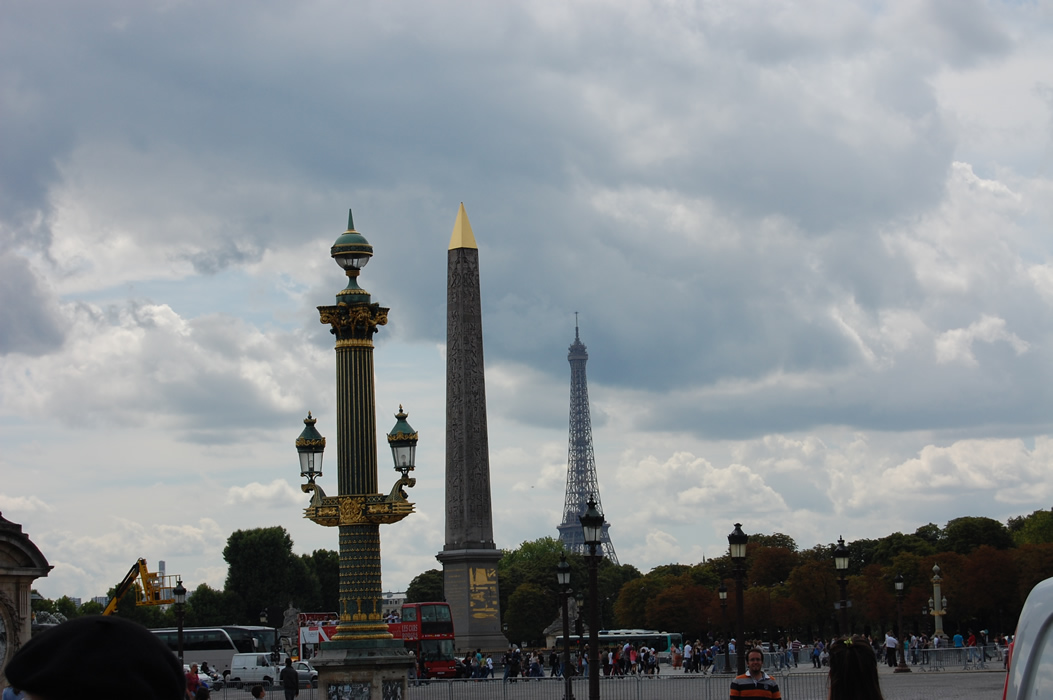
After Les Invalides, we headed off for another Tour.  This one (as seen from the wet and rainy Batobus river cruise a day or so before):
The building is a gorgeous latticework of metal, even when just seen from the ground:
We'd booked ahead (for the others, not me - I don't do high things) - so all queues were avoided.  As I didn't ascend, the next few photos are by younger son.  (And there are others scattered through the other Paris posts...)


Tuesday, 23 August 2011

Paris 3: Tour, Invalides

 24th July 2011.  The Final day of the Tour de France; Mark Cavendish wins the Green Jersey. It was teriffically crowded on the Champs Elysees, even relatively early in the morning.
The very centre of Paris was closed to traffic, and all the attractions we'd been interested in (eg an exhibition in the Grand Palais) were closed. 

So we left and wandered over to Les Invalides. We sat for a while outside, by the highly ornate Pont Alexandre III before we went in.
The Les Invalides complex includes the Tomb of Napoleon as well as several museums and collections.  We went for the collection of arms and armoury.
 Including this marvellous dragon-crested Chimera Helmet

Saturday, 20 August 2011

Paris 2: Louvre, d'Orsay, Pantheon

After Notre Dame, we had a tour up and down the Seine followed by supper in the Latin Quarter.  The next day we were up early (on advice) and headed for the Louvre.
The reason for going early was to avoid the crowds heading for the Mona Lisa.
 
So that worked well.
 In fact, the galleries were crowded all around the painting.
So we headed for a quieter, less famous Leonardo:
We had intended merely a quick whistlestop, 'smash and grab' raid on the Louvre, just a quick look at one or two famous old masters and out.  Instead we got seduced, and wandered around quite a number of galleries looking at stuff.  And such stuff!

But the other star of course, is the Louvre itself - particularly the new, underground spaces beneath the Pyramid - the connecting areas which pull it all together.  Absolutely marvellous.

After the Louvre we wandered through the Jardin des Tuileries...
...and then over the new footbridge (at least I don't recall it from last time) to my favourite art gallery - the Musée d'Orsay.  And I do mean the gallery of all those that I've been to that I love the most of all, anywhere.

It isn't just that it is housed in a refurbished and repurposed railway station (so much more romantic than Tate Modern's power station), nor the sumptuousness of the original building.  It is mostlly the art.  All those impressionists and post-impressionists.  Favourite Monets, Manets, Cezannes and Van Goghs.  Whistlers Mother (that isn't its real title).  Delacroix, Daumier, Rousseau, Millet (a new fave), Courbet, Renoir, more Monet, Pissarro, Caillebotte, Sisley, Degas, Berthe Morisot, Redon.  And Seurat, Signac, Toulouse-Lautrec, Gauguin, Bonnard, Vuillard, Klimt and Munch.  Aaaah.

However, the gallery was going through a major refurbishment and rehang when we were there (just finished  now, according to the Web site), so all of the most famous works - and very many of those I most wanted to see - were on temporary display.  ALL IN THE SAME CORRIDOR.  We had thought the Louvre was crowded, but that was nothing to the number of people in that corridor.

But I ignored them all and enjoyed myself hugely in my favourite arty space.  (Hence no photos).
The Panthéon was new to me: 
According to Wikipedia:
"It was originally built as a church dedicated to St. Genevieve and to house the reliquary châsse containing her relics but, after many changes, now functions as a secular mausoleum containing the remains of distinguished French citizens."
Which is fair enough, but doesn't really convey the overwhelming French Nationalism that pervades the state.  This is a cathedral to secular male Frenchness.  The state and its instruments.
 
The building is huge, and awesome in its own right.  The statues and other memorials scattered around it are large in themselves but can seem overwhelmed by the place.  We wandered and pondered.
 Diderot, famous for the Encyclopédie, ou dictionnaire raisonné des sciences, des arts et des métiers.
Apparently one of Foucault's first pendulums was originally set a-swinging in the Pantheon, although this is a replica.  The original bob he used then is at the the Musée des Arts et Métiers - as any reader of the Eco novel will (of course!) recall.
The latin apparently translates to "Christ tells the Gallic angel to guard the fate of the fatherland" - very much in keeping with the nationalistic and patriotic tone of the place.
 Georges Guynememer I believe, a WWI flying ace.
 Statue to the glory of "La Convention Nationale".
The author of The Little Prince.

And I've missed out all the others, like Voltaire, Victor Hugo, Carnot, Emile Zola, the Curies and Dumas pere.  Many of whom are buried in the crypt underneath.

So anyway, after that we wandered down to the Latin Quarter and had a cheap supper in a kebab shop... Very French!