Wednesday, 4 June 2025
Sunday, 19 May 2024
Remembering Ken Brown, 10 Years On
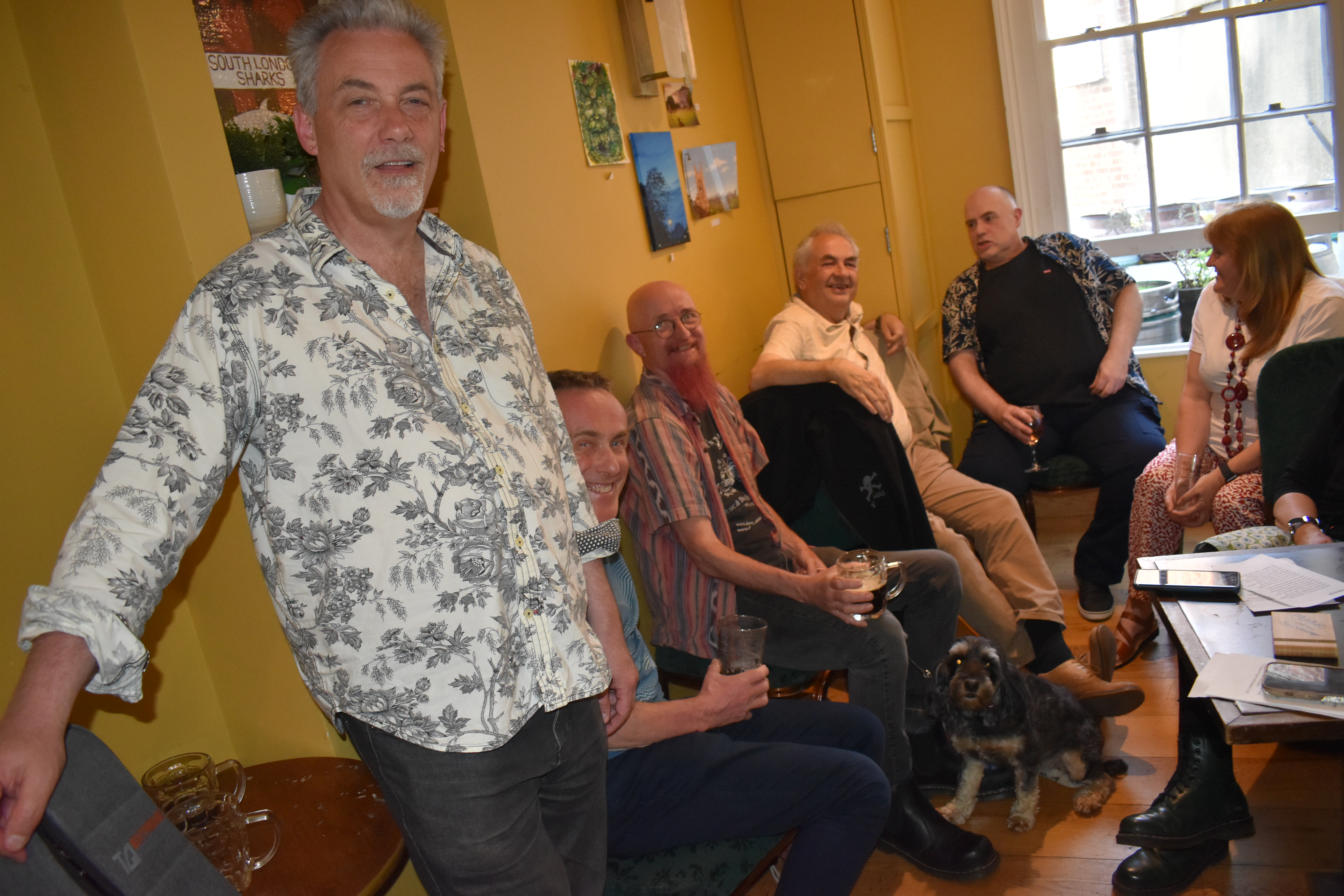
A few friends remembering the much-missed Ken Brown at the Shirker's Rest in Lewisham.
With Lewisham Labour Club, Abi, Claire and Alice.
Music, stories and reading. Much joy.
Monday, 28 August 2023
Thwarting Evil Wiles
"Crowley looked up slyly.“'Then you can't be certain, correct me if I'm wrong, you can't be certain that thwarting it isn't part of the divine plan too. I mean, you're supposed to thwart the wiles of the Evil One at every turn, aren't you?'"Aziraphale hesitated.“'There is that, yes.'“'You see a wile, you thwart. Am I right?'“'Broadly, broadly. Actually I encourage humans to do the actual thwarting. Because of ineffability, you understand.'“'Right. Right. So all you've got to do is thwart."
Saturday, 29 January 2022
... and the View from the Pratchett Estate...
From The Guardian 27/1/2022
Terry Pratchett’s estate has authorised Jack Monroe to use the “Vimes Boots Index” as the name of her new price index, which is intended to document the “insidiously creeping prices” of basic food products.
The author’s daughter, writer Rhianna Pratchett, said her
father would have been proud to see his work used in this way by the anti-poverty
campaigner. Monroe was prompted to create her index after inflation jumped to
5.4% last week, and she found herself “infuriate[d]” that the index (the
consumer price index or CPI) used for this calculation “grossly underestimates
the real cost of inflation as it happens to people with the least”. She laid
out how the prices of “value” product ranges in supermarkets had soared over
the last decade – rice in her local supermarket had increased in price from 45p
for a kilogram bag last year, to £1 for 500g, a 344% increase – and how the
number of value products has shrunk. She was soon working with economists,
charities and analysts to compile her own index.
“One,” she wrote in the Observer, “that will document the
disappearance of the budget lines and the insidiously creeping prices of the
most basic versions of essential items at the supermarket” and “serve as an
irrefutable snapshot of the reality experienced by millions of people”.
In a tweet on Wednesday, Monroe announced that the index is
already starting to make a difference, as the Office for National Statistics
has admitted that “one inflation rate doesn’t fit all”. She wrote: “Delighted
to be able to tell you that the @ONS have just announced that they are going to
be changing the way they collect and report on the cost of food prices and
inflation to take into consideration a wider range of income levels and
household circumstances”, using the hashtag #VimesBootsIndex.
The index, Monroe said, is named in honour of Pratchett’s
creation Sam Vimes, who in the Discworld novel Men at Arms lays out the “Sam
Vimes ‘Boots’ theory of socio-economic unfairness”.
“The reason that the rich were so rich, Vimes reasoned, was
because they managed to spend less money,” wrote Pratchett. “Take boots, for
example. He earned thirty-eight dollars a month plus allowances. A really good
pair of leather boots cost fifty dollars. But an affordable pair of boots,
which were sort of okay for a season or two and then leaked like hell when the
cardboard gave out, cost about ten dollars. Those were the kind of boots Vimes
always bought, and wore until the soles were so thin that he could tell where
he was in Ankh-Morpork on a foggy night by the feel of the cobbles. But the
thing was that good boots lasted for years and years. A man who could afford
fifty dollars had a pair of boots that’d still be keeping his feet dry in ten
years’ time, while a poor man who could only afford cheap boots would have
spent a hundred dollars on boots in the same time and would still have wet
feet.”
The Pratchett estate has authorised the use of the name,
tweeting its own Pratchett quote in support of Monroe’s campaign. “Sometimes
it’s better to light a flamethrower than curse the darkness,” wrote the late
Discworld author in Men at Arms.
Rhianna Pratchett said: “My father used his anger about
inequality, classism, xenophobia and bigotry to help power the moral core of
his work. One of his most famous lightning-rods for this was Commander Vimes of
the Ankh-Morpork City Watch - a cynical, but likable, man who attempts to
better himself whilst railing against the injustices around him. Some of which
he’s had a hand in perpetrating in the past.
Monday, 13 July 2020
Saturday, 12 October 2013
Gaiman Live
I may have to stop hating it.
Sunday, 10 March 2013
The Big Bang Visitor Experience Theory
At its simplest, part of the attraction arises from the fact that most of the leads are physics or engineering geeks. Or uber geeks. Sheldon et al have huge IQs and problematic social skills. And you can't help loving them.
It is great that the main characters are interested in string theory, anisotropic universes and astronautics. They love tech, and they are also into Stars Wars and Trek, Dr Who, comics, costumes and conventions. And they are surrounded by a bunch of other clever scientist people (and Penny).
Of course, as well as all the nerdy stuff, the other half of the show is admittedly more traditional - it's about relationships and love and stuff, and just how metrosexual is Raj? But it does all seem to fit together; we like watching these gawky individuals navigate a world full of other people. The main characters are outlandish, at various places on the spectrum (of clever-idiocy, if nothing else), but likeable.
But mostly I think I like it because physics is in some way at its heart.
However, thinking about the show recently I realised that it has a significant weakness, and an obvious one. The gang are keen on costumes and media SF, but they don't appear to read fiction. They don't talk about Pterry, or China or Iain or Robert A. When they argue over Star Trek or Babylon 5 they don't say a word about the writers. Never a mention of The City on the Edge of Forever. They appear to hold no opinion about Dean R Koontz.
This may be partly because they still have an audience to connect to - there have to be points of contact which aren't too obscure. Which is why they talk about Batman and the Flash rather than Rorschach or Dr Manhattan. But the chief reason is more obvious.
It's because it's on the telly.
Some time back, a fashion started amongst museums and galleries and their ilk to become more open to the public. To let us 'behind the scenes' to see what they did with our money, and why they ought to be cherished.
This resulted in lots of new buildings being designed and built to allow this to happen, and the signature element of many of these new ventures was the glass wall. Physically transparent, it served as the thinnest possible membrane between the public and the behind-the-scenes experts who researched, conserved and curated the displays. The Darwin Centre is an obvious example in London, but there are many others.
London Zoo caught this fever too. I recall going to the newly Biodiversity Centre a few years ago, just after it opened. An attractive, multi-level triangular building towards the southern corner of the site. And yes, there were these huge glass walls opening on the keepers' offices, so we could see what they did at work.
I only once, ever, saw anyone doing anything in those rooms.
He was reading a book.
Doubtless a worthy and interesting book, about ants or cephalopods or the care and feeding of giraffes, but it didn't make a compelling visual feast. There was no crowd of happy visitors clustered around the glass wall, watching him turn the pages.
It just wasn't good telly.
And that, I suspect, is ultimately why Sheldon, Leonard, Howard and Raj don't read SF, don't ever compare notes on the Culture or Discworld or Lundun. Visually, it just ain't got it. That is why they'll buy a George Pal Time Machine at auction, but never discuss Wells' original novella.
Having all four of them dress as the Flash is just so much funnier. But that don't make it true.
Saturday, 5 November 2011
Awful
In the science fiction TV show Red Dwarf, the cat is slick and one step ahead of the rest of his crew mates.This is typical of the errors and misreadings that occur throughout Craig Cabell's "Terry Pratchett: The Spirit of Fantasy" (2011). A truly awful book - don't buy it.
Monday, 7 February 2011
On Kingship
The most appropriate job - he asserts, correctly - is to get a role in the public sector where you have to work closely with large numbers of people/subjects.
Many European monarchies have gone part way towards that ideal.
So, our current scummy, dysfunctional, horribly right-wing, lower-middle-class, caniphilic, German Royal family should learn from this. Harry or Wills should become Hospital porters, social workers or Librarians.
But they don't.
Instead they pretend to be important, and start creating unhelpful, unpleasant, distracting events only ever intended to stop us protesting about the Old Etonian, Establishment, stupid rotters who are currently in charge. Just like their Dad.
They do the circuses in bread and circuses.
Crap, really.
Completely second-rate...
Sunday, 2 January 2011
Inordinately
And the phrase certainly gets around, including Pterry's conclusion that the God who is fond of beetles is - paradoxically - the God of Evolution (see The Lost Continent)...
Its also worth noting that On Being the Right Size does not end up as an essay about comparative anatomy. The last two paragraphs read:
And just as there is a best size for every animal, so the same is true for every human institution. In the Greek type of democracy all the citizens could listen to a series of orators and vote directly on questions of legislation. Hence their philosophers held that a small city was the largest possible democratic state. The English invention of representative government made a democratic nation possible, and the possibility was first realized in the United States, and later elsewhere. With the development of broadcasting it has once more become possible for every citizen to listen to the political views of representative orators, and the future may perhaps see the return of the national state to the Greek form of democracy. Even the referendum has been made possible only by the institution of daily newspapers.So he's actually using arguments from biology to question whether socialism is able to run large Nation states or Empires. Can it ever be used effectively to run the British Empire? Haldane was a socialist for much of his life, but he could and did apply a sense of scientific scepticism to his ideology.
To the biologist the problem of socialism appears largely as a problem of size. The extreme socialists desire to run every nation as a single business concern. I do not suppose that Henry Ford would find much difficulty in running Andorra or Luxembourg on a socialistic basis. He has already more men on his pay-roll than their population. It is conceivable that a syndicate of Fords, if we could find them, would make Belgium Ltd or Denmark Inc. pay their way. But while nationalization of certain industries is an obvious possibility in the largest of states, I find it no easier to picture a completely socialized British Empire or United States than an elephant turning somersaults or a hippopotamus jumping a hedge.
He was a somewhat controversial figure to some. From Wikipedia:
Haldane was a friend of the author Aldous Huxley, who parodied him in the novel Antic Hay (1923) as Shearwater, "the biologist too absorbed in his experiments to notice his friends bedding his wife". Haldane's discourse in Daedalus on ectogenesis was an influence on Huxley's Brave New World (1932) which features a eugenic society.- and Weston is of course the baddie.
C.S. Lewis wrote much of his three interplanetary space novels, The Space Trilogy, in response to Haldane, whom Lewis considered to be an immoral man. Lewis modelled the character Weston, featured in the first two books, Out of the Silent Planet and Perelandra, on Haldane.
Much of this also ties in quite nicely with the Mark Miodownik RI Christmas lectures (not the bit about sleeping with his wife, but the linking across disciplines and the predictive, futures-oriented visionary scientific rhetoric).
And of course Haldane was known for a clutch of other quotations, including:
My own suspicion is that the universe is not only queerer than we suppose, but queerer than we can suppose.
Theories have four stages of acceptance:
i. this is worthless nonsense,
ii. this is interesting, but perverse,
iii. this is true, but quite unimportant,
iv. I always said so
Which sounds a very familiar position, to me at least.(Source unknown)
Sunday, 21 November 2010
Brollies
The author's eyes would light upon that constant to almost all writers: a cup of a warm, mildly stimulating beverage, usually coffee, and they would use this desperately, somehow, anyhow, to pad out the text and prod their narratives back into life.
Klatchian coffee. Black wine.
In a more mundane vein, I do the same when I'm attempting to solve the crossword and I'm lost for inspiration. I look around, seeking help anywhere. Thankfully, the Guardian helps with short articles of interest, appropriate to the back page, alongside the grid. Weatherwatch, Starwatch, Spacewatch. Rarely dull.
And, to be scrupulously honest, they rarely help directly with the crossword.
A week ago on Friday, Kate Ravilious wrote in Weatherwatch:
Umbrellas first emerged in dry, hot places, to provide protection from the hot sun. The word umbrella comes from the Latin word "umbra", meaning shade or shadow. It isn't clear where and when the very first umbrella was made, but evidence from India, China and Egypt indicate that umbrellas have been around for more than 4,000 years. The Chinese were the first people to make waterproof umbrellas, by waxing and lacquering the paper parasol cover. Eventually umbrellas caught on in the west, especially northern Europe, during the 16th century. Many of these umbrellas were made from wood or whalebone and had oiled canvas parasols.Which was a piece I quietly enjoyed (despite the weakness of the last line about 'every British household'), but it put me in mind of a more political take on the brolly by Neil MacGregor, presented to staff at the British Museum a few years ago (I was staff then).
Amazingly they didn't find favour in soggy Great Britain until the Restoration, in the late 17th century. Rumour has it that the Puritans' disapproved of such frivolous devices, which would prevent Heaven-sent rain from properly wetting a person.
However, when umbrellas did arrive in Great Britain, the unpredictable climate soon made them popular. Coffee houses started the fashion; providing umbrellas to shelter customers as they walked to their carriages. At first they were considered a woman's accessory, but when English traveller and philanthropist Jonas Hanway began to carry one during the mid 18th century, men began to adopt them too. By 1830 the UK had its first dedicated umbrella shop in London, and nowadays every British household usually has at least one umbrella.
He looked at images across cultures and history showing umbrellas and sunshades, and found that in an awful lot of them they were used to show a power relationship. The servant shades the Lord or Queen, protecting them from the elements while having no cover themselves. From overlords in ancient middle-Eastern cultures reviewing grain harvests to 1930s politicians speaking at rallies in wet North-of-England rain, the brolly shows who is important and who is not.
Now it would, I think, be perfectly possible to construct an argument that the BM, built in part upon the spoils of political power, still can't avoid probing and testing issues of power, morality and hierarchy, like a tongue testing out a rotten tooth. While the Guardian article by contrast is more free, and about personal use - liberal without even thinking about it. Aren't stereotypes wonderful?
However, I'm minded instead to think about the UK's "first dedicated umbrella shop" - that Ravilious mentions in her piece. This is James Smith and Sons, established 1830 and still going strong in New Oxford Street. An establishment brand, the tiniest of walking distances from the Museum.
And I have to say, at the time a few of us suspected it was the inspiration for the Director's talk. You can see how it might happen, inspiration briefly fails, not even the black wine helps, so you decide to nip out for a walk around the block to clear the mind and get the creative juices flowing again. And the first thing you spot is...
Brollies. That will do nicely.
(Of course, I'm writing this after a week off, when I haven't felt minded or inspired to post much at all. So maybe this whole meander is just my version of Klatchian coffee...)
Sunday, 24 January 2010
Poem of the Week
Terry Pratchett
I do have worlds enough and time
to spare an hour to find a rhyme
to take a week to pen an article
a day to find a rhyme for 'particle'.
In many worlds my time is free
to spend ten minutes over tea
And steal the time from some far moon
so words can take all afternoon,
Away beyond the speed of light
I'll write a novel in one night.
Aeons beckon, if I want 'em......
... but I can't have em', 'cos of Quantum.
Sunday, 17 January 2010
Spain Tour 18: Valporquero Caves
Eventually we swooped down the last hill in a long curve to the car park and visitor centre.
View Larger Map
There are no cameras allowed in the caves, so the best way to suggest what we saw is to link to another site.
The cave complex is startling, and wonderful to walk around - every turn throws up a new and different formation. One of the outcroppings looks just as I imagine the lime-covered Dwarf King in the Koom valley caves in Thud!.
Thursday, 22 October 2009
On Continuity
And now in the space of a few days we have Radio 4 broadcasting Eoin Colfer's authorised sequel to Hitchhiker and a brand new Discworld novel. I really need Andy to tell me what to think about them, but as he isn't here right now (he's in SW London), here goes...
Unseen Academicals - 37th in the Discworld series. Its about football and the wizards. It is pretty good. Somehow, it reminds me of Monstrous Regiment (perhps because when Pterry writes about the working classes and violence there is a certain similarity?). I'm not going to talk about plot, character or jokes. If you are interested you will have already read it - or be about to. So in either case I'd be doing a disservice. But there is one other area where it reads as typical Pratchett. He has never been that interested in the detailed consistency of the series from book to book. In fact I always thought the whole point of Thief of Time was to allow him to do pretty much as he wanted in that regard, without the fans getting niggled.
And yet. In this book, football is reinvented, and indeed a new, air-filled ball is introduced. The game is made more civilised. All fine, except that it seems to ignore the byplay around Captain Carrot and his inflated pig's bladder in Jingo. The Captain Carrot who doesn't appear in the latest book at all, because of course he would be the ideal referee, and the main plot just wouldn't quite work. Now it is clear that Pratchett knows and understands this discontinuity and just doesn't want to let it get in the way of his story. Fair enough - its his universe, after all. It's just that this time I felt the gap a little bit more clearly...
Anyway, on to And Another Thing. The next bit of HHGTTG. Part six of three. I haven't bought the book (yet - I probably will for completeness), and I admire Colfer (Artemis Fowl, The Wish List, etc). But first and foremost Hitchhiker was a radio series, and that is the form where it worked best, so when Radio 4 announced that they would broadcast it as Book at Bedtime I decided I just had to listen to it first.
A big mistake. A huge mistake.
Because it was Book at Bedtime. A solitary voice reading a condensed version of the book. Dull. No Peter Jones (or Stephen Fry). No music. No BBC Radiophonic Workshop. No Simon Jones. Nothing. I suspect that if in my mind Hitchhiker wasn't actually all of those things, and more, it would have been OK. But it is. So it wasn't.
I just couldn't listen to it and had to switch it off.
There was no continuity with the past, no sense that this followed on from the earlier stuff; it just fell depressingly flat. Either it is just me, or the BBC got this one horribly wrong. Once upon a time, I feel sure, Andy Crook would have warned me.
Wednesday, 31 December 2008
Arise, Sir Pterry
Jolly good.