Sunday, 13 February 2011
Peckham Rye Tree Trail - 2
I think we were flummoxed. We just weren't sure without the leaves. But these may be they:
However wrong or right we were about the mulberries, the next was easy - a group of blue-leaved Atlas cedars (Cedrus atlantica 'glauca'). Cedars, and blue leaved, not hard to spot.
But then we hit a real hitch - the next tree we were directed to was the nearby Horse Chestnut (Aesculus hippocastanum). Easy you might think
Except there wasn't one there. Or anywhere near. After a lot of searching and several reviews of the map we spotted this:
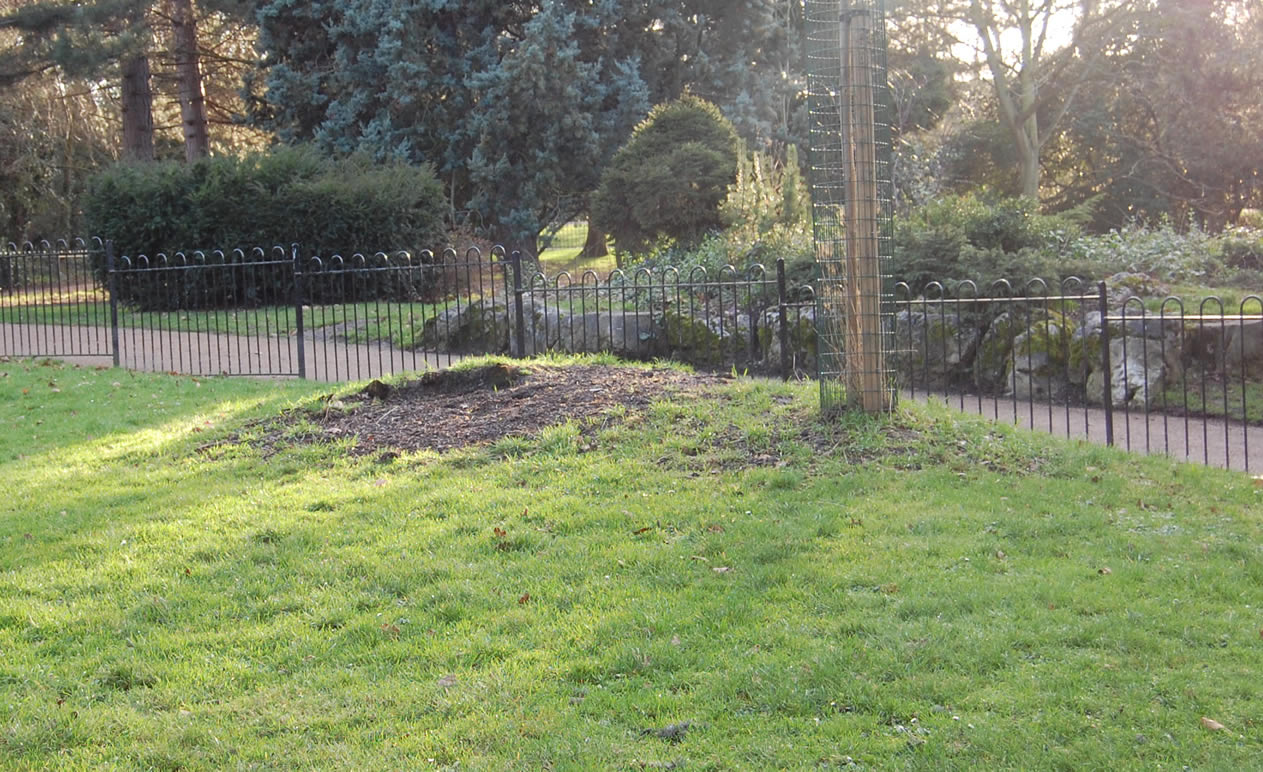
The site of an ex-Horse Chestnut? Just how old was this Trail? The little yellow booklet had no date on it, but the contact phone number began 071.
OK. The fount of all arcane knowledge Wikipedia tells us that '071' came into use as the prefix for Inner London in May 1990, and changed again to '0171' on 'phONE day' (16 April 1995) - 0207 only arrived in April 2000. Which means that the Tree Trail Guide must have been written between 1990 and 1995 - at least 15 years ago. We may well have a copy that was still being produced a little later than that (they probably didn't bother to change the phone number straight away), but it means that the document is probably at leasst 12-13 years old.
So trees may be missing. They may have fallen or been felled. A new challenge. And that little patch of disturbed earth, next to a newly-planted tree, probably marks where the Horse Chestnut once stood.
After the sad Horse Chestnut site, the Trail led us to a collection of trees, all quite close together on the map. A Sweetgum, (Liquidamber styraciflua), a (Red) Indian Bean tree (Catalpa bignonioides), a purple-leaved (sic) Norway maple (Acer platanoides, 'Goldsworth Purple'), a Dawn Redwood (Metasequoia glyptostroboides) and a Box Elder (Acer negundo). But which was which? This is what we could see:-
and we wandered amongst them getting quite confused until help arrived in the sign of, well, a sign:
So that was the (Red) Indian Bean.
Which probably made this the maple:
and this was clearly the tall Redwood:
So this was therefore the box elder - possibly:
,,, and the sweetgum must be the small tree on the far right of the earlier group shot.
By that stage I felt like I was playing one of those TV quizzes where you have to get five objects into five holes and hit a button - after which the host tells you what an idiot you've made of yourself. Even if we identified them properly at the time, I'm sure I may have the photos in the wrong order!
But finally, an easy spot came along. Two eucalyptus trees (Eucalyptus gunii).
The Trail next guided us to look at the Wisteria (Wisteria sinensis) along the outside of the Sexby gardens.
This we did with reservation, because we don't think it counts as a tree! There is one real tree inside the gardens, a Ginko tree (Ginkgo biloba):
And then we were on a run. Two huge London Planes (Platanus hispanica),
a Weeping Willow (Salix chrysocoma) by the lake
and a group of Yew (Taxus baccata)
Straightforward.
The next tree on the Trail was meant to be a White Willow (Salix alba) - but it was nowhere to be seen. Not another missing tree? We felt in need of sustenance before unravelling another conundrum, so we kind of gave up and headed off to the new cafe (the old one indicated on the Trail map was demolished years ago).
The cafe was warm inside and we lingered over coffees. In the distance was the horrible, growing, Tolkienesque Shard.
We felt exposed, and wanted to be indoors, away from the all-seeing Eye.
So we went home.
Wednesday, 25 November 2009
Symbolism at D's House
Anyway, D. has bought another house on our road, so we went along to have a nose around. Apart from a few accessibility adaptations, the house seems virtually unchanged from the 1960s.
This magnificent print above a condemned fireplace gives a flavour of the decor:
It is one of those mass-built houses built - I guess - in the mid-nineteenth century to cater for London's huge expanding middle classes.
Although actually knocked up in something of a hurry according to one of our builder neighbours, they seem quite sturdy and - more importantly - very large to contemporary eyes.
However, D. has assured all of his new neighbours that he isn't interested in turning this into flats. Just do it up, make it all very sound, and sell it.
The gardens out back aren't huge, but there is quite a lot you can do with them.
Some of the house only seems dingy because it is grubby, and shaded by grey unwashed net curtains. It creates a seriously sad feeling.
Out in the back there is a kitchen extension which probably once felt light and airy, but now, to me at least, just feels damp and grubby.
But then I peeked out of the back door. What was this? I could only get half a view...
A huge Yew tree covering half the back garden. Traditional symbol of death and illusion. Poisonous. This is just part of the Wikipedia entry:Germanic folk too, have thought the yew tree important, as the World Tree Yggdrasil is often said to be a yew.
The yew is often found in church yards from England and Ireland to Galicia; some of these trees are exceptionally large (over 3 m diameter) and may be over 2,000 years old. It has been suggested that the enormous sacred evergreen at the Temple at Uppsala was an ancient yew tree.[13][14] The Christian church commonly found it expedient to take over these existing sacred sites for churches. It is sometimes suggested that these were planted as a symbol of long life or trees of death. An explanation that the yews were planted to discourage farmers and drovers from letting their animals wander into the burial grounds, with the poisonous foliage being the disincentive, may be intentionally prosaic.
Yew is also associated with Wales and England because of the longbow, an early weapon of war developed in northern Europe, and as the English longbow the basis for a mediaeval tactical system. Yew is the wood of choice for longbow making; the bows are constructed so that the heartwood of yew is on the inside of the bow while the sapwood is on the outside. This takes advantage of the natural properties of yew wood since the heartwood resists compression while the sapwood resists stretching. This increased the strength and efficiency of the bow. Much yew is knotty and twisted, so unsuitable for bowmaking; most trunks do not give good staves and even in a good trunk much wood has to be discarded.
The trade of yew wood to England for longbows was such that it depleted the stocks of good-quality, mature yew over a vast area. The first documented import of yew bowstaves to England was in 1294. In 1350 there was a serious shortage, and Henry IV of England ordered his royal bowyer to enter private land and cut yew and other woods. In 1470 compulsory archery practice was renewed, and hazel, ash, and laburnum were specifically allowed for practice bows. Supplies still proved insufficient, until by the Statute of Westminster in 1472, every ship coming to an English port had to bring four bowstaves for every tun. Richard III of England increased this to ten for every tun. This stimulated a vast network of extraction and supply, which formed part of royal monopolies in southern Germany and Austria. In 1483, the price of bowstaves rose from two to eight pounds per hundred, and in 1510 the Venetians would only sell a hundred for sixteen pounds. In 1507 the Holy Roman Emperor asked the Duke of Bavaria to stop cutting yew, but the trade was profitable, and in 1532 the royal monopoly was granted for the usual quantity "if there are that many." In 1562, the Bavarian government sent a long plea to the Holy Roman Emperor asking him to stop the cutting of yew, and outlining the damage done to the forests by its selective extraction, which broke the canopy and allowed wind to destroy neighbouring trees. In 1568, despite a request from Saxony, no royal monopoly was granted because there was no yew to cut, and the next year Bavaria and Austria similarly failed to produce enough yew to justify a royal monopoly. Forestry records in this area in the 1600s do not mention yew, and it seems that no mature trees were to be had. The English tried to obtain supplies from the Baltic, but at this period bows were being replaced by guns in any case.
In the Central Himalayas, the plant is used as a treatment for breast and ovary cancer.
The house is an explicitly man-made layering, but then so also is the yew, I guess, in that we superimpose our own thoughts and values onto the plant.
(Although to be fair, in the house the layer may simply be the result of some particularly garish nineteen-sixties wallpaper!)
We also came across a newspaper from 1947 in which a report recorded that the landlord of the Waverly Arms had been found guilty of watering down his Gin...
But then there was the Yew again, with all of its iconography.
I felt I had to combat the symbol with another symbolic tree - and in the next door garden was the perfect thing.
A Christmas Tree! A Norwegian spruce I would guess (with a longer Wikipedia entry than the Yew - how symbolic is that?)
Outside also, the beautiful red/brown leaves (from those trees that shed in the Autumn) had coated the front step and garden to fantastic effect. I was back in ordinary life, looking at things to see what they looked like, as it were, rather than allowing all of the rich dark allusions of D.'s new-old house and garden to overwhelm me!Sunday, 25 October 2009
Autumnal Nunhead
. . . the leaves have just begun to turn, and the trees are a blaze of variegated greens, yellows and reds.


I was somehow taken by these red berries against the green rubbish bin (!)
Near the junction of Nunhead Lane and Consort Rd there is this magnificent bay tree (? or so I'm told it is):-
On the corner, and along towards the green, it still seems quite summer-y. . .
I was also quite taken by this tree leaning (not, as it appears from this angle, against a house) on Scylla Rd.
Nunhead seems to be slowly losing pubs. In the last few years several have closed and the other week there was a for sale sign outside the Old Nun's Head. The Rye Hotel gastropub, however, was very busy today. Parked outside the pub were a whole bunch of classic motorbikes and sports cars. And chaps in flat caps chortling to each other.
Below are images of the view across the North end of the Rye from outside.
I didn't feel comfortable taking a photograph while they were all standing around, so I waited until some of the bikers set off...
. . . and then back to the autumnal trees. . .