Showing posts with label Ken Brown. Show all posts

Thursday, 9 October 2025

We Thought We'd Share This...

 ... because we have a Chapter in it!


Available here.


Saturday, 6 September 2025

On Amol On UC

 University Challenge has only had three question masters.  

Bamber Gascoigne (1962-1987), who always gave the impression that he knew more than anyone else in the room, and that he probably wrote the questions, while at the same time giving out a real sense of enthusiasm.  We did meet him once, back in the 1970s, when Durham were in the final. (I wasn't on the team, but the much-missed Ken Brown was).

Jeremy Paxman (1994-2023) was the second person to take the role. He came over as the arch-inquisitor, not suffering fools gladly.  Replaying his persona as questioner on Newsnight and other current affairs programmes into the UC role.  But he lacked Bamber's warmth.

And so to Amol Rajan. To be honest, we haven't had that much time for him as a journalist, either at the Independent or on the BBC Today programme.  He seemed to us to come across as both shallow and a know-it-all.  An amazing trick.  However, he has done very well, we think, in the UC job.  To our surprise.  He shows Bamberish enthusiasm, and glints of knowledge, while still being firm.  

A success, we believe.


Sunday, 26 May 2024

Sung At The Event For Ken

 I've been drinking in the Ornithologists' Arms

Come with me, let's go there now
We'll drink to the revolution
We'll drink to the avian population
We'll drink and drink we'll talk and talk, we'll talk and drink some more
'Cos you can't save the birds without saving the planet
And you can't save the planet under capital
Under capital

We'll have a pint with the country postman
He'll talk of early morning owls
And of night-jars in the mist
And how his management take the piss
And singers and poets and all value freedom
Will talk of birds on the wing
And the songs of freedom that they sing
And the flight of the peregrine

I've been drinking in the Ornithologists' Arms
Come with me, let's go there now
We'll drink to the revolution
We'll drink to the avian population
We'll drink and drink we'll talk and talk, we'll talk and drink some more
'Cos you can't save the birds without saving the planet
And you can't save the planet under capital
Under capital

And the sign of the pub is a giant murmuration
It's starlings practising mutual aid
And on the bookshelf sits battered old Kropotkin
He was more than red in tooth and claw
And on the walls hang old binoculars 
That date from early in this age of extinction
Charts of sea levels rising

I've been drinking in the Ornithologists' Arms
Come with me, let's go there now
We'll drink to the revolution
We'll drink to the avian population
We'll drink and drink we'll talk and talk, we'll talk and drink some more
'Cos you can't save the birds without saving the planet
And you can't save the planet under capital
Under capital

And the vagrants and the migrants are all equally welcome
Yes the vagrants and the migrants are all equally welcome
It's not like here, it's not like here
Yes the vagrants and the migrants are all equally welcome

I've been drinking in the Ornithologists' Arms
Come with me, let's go there now

Sunday, 19 May 2024

Remembering Ken Brown, 10 Years On

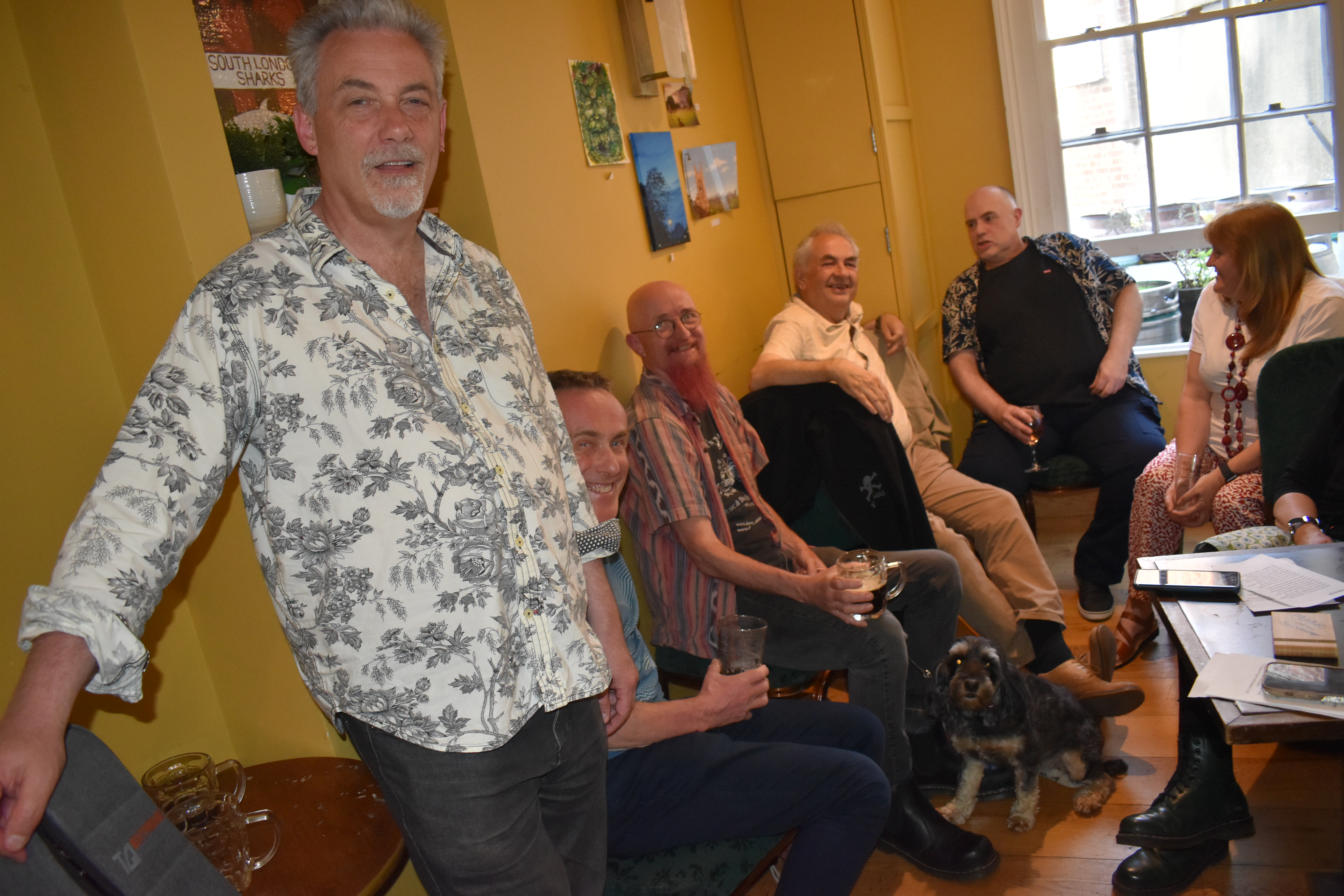
 A few friends remembering the much-missed Ken Brown at the Shirker's Rest in Lewisham.
With Lewisham Labour Club, Abi, Claire and Alice.
Music, stories and reading.  Much joy.


Tuesday, 17 August 2021

Mild Cheddar

 Another of Ken's Writings has come to light...


Mild Cheddar

I was walking around Brighton with a grumpy 8-year-old. I wanted to eat - it was a hot day, I'd had no breakfast or lunch, and I hadn't recovered from the night before's hangover. She wanted to hang around on the beach and play slot machines. I wanted to eat something out of the ordinary. I she wanted to eat chips and tomato ketchup, washed down with chocolate cake.

She won. After I'd fell into the age-old parental trick of throwing my weight around and saying "because I told you so", and bought off the resulting tantrum with ice-cream and cola on a deck chair in the Pavilion gardens (which involved another tantrum over which tree the chair should be shaded under), we finally got into the most boring cafe on Sidney Street by about half-past six. I had some rubbery squid and chips, feeling as if I'd gone to all the way to Charing Cross Road and found only books by Lord Archer. She had a baked potato and cheese.

Except of course that they always call them jacket potatoes in places like that. Why on earth do they do that? What a stupid name. Do they have tie potatoes or waistcoat potatoes or T-shirt potatoes or skid-marked Y-front potatoes? Do we eat jacket bread or jacket pies? They are baked in an oven and they are baked potatoes.

And it has got to be a real oven. Every now and then some food illiterate claims to make great baked potatoes in a microwave oven. You can't bake anything in a microwave, they aren't baked potatoes they are badly-cooked boiled potatoes, overdone and dry in the middle and surrounded by a half-centimetre thick layer of dusty, grainy yellowing stuff that peels off the outside and won't absorb the butter. Even with the heater attachment they aren't remotely like baked potatoes. Maybe microradio-oveners (as a German might put it) don't actually like baked potatoes, and are quite glad to get away from the chore of eating all that crispy skin and the yellow chewy bits that form under it and the little air pockets that your butter and cheese soaks into.

Anyway this was a baked potato, as well-cooked as you have any rational expectation of in a place like that, and it came with loads of salad (which I ate of course, except for the cucumber which seems to be the only uncooked vegetable most kids can eat for some reason) and a huge heap of grated cheese.

She took one bite and her face fell.

"I was stupid to ask for this, Daddy" she said.

"I should have realised.

Mild Cheddar.

You always get mild Cheddar in places like this".

She ate as much as she could. But it wasn't much. She managed to scrape most of the cheese off and soak butter into some of the potato and eat it with salt. But the meal was ruined. There is only so much you can take. I had to buy her the chocalate cake in the end. We won't be going back. 

Mild Cheddar. What the hell is it for? Why does anyone make it, sell it, buy it or eat it? It hardly tastes like cheese at all, more like slightly rancid surprisingly solidified over-salted unimaginitively bland butter. It is crap.

OK, it is cheap. But it's not the cheapest cheese - there are many common varieties of slightly less foul Dutch-style cheese that you can't buy in the Netherlands, which are at least marginally edible.

And yet half of all the cheese you see in shops in England is mild Cheddar. In the USA (which is a wonderful country in many ways but not a cheese-lovers paradise) all the cheese you see in most shops is one form or another of mild Cheddar, even though they give it silly names - "Monterey Jack" or "Colby" or even "Brick".

No wonder the French think we can't make cheese. Real Cheddar cheese (most of which seems to come from Canada or Australia these days - or even the USA, they can make good cheese over there but no-body ever seems to buy it except as a "gift idea" in little wooden boxes packed with artificial straw) is a heroic cheese, one of the world's greatest food experiences. So it costs twice as much - just buy half as much. It's worth it.

It's not just that I don't like mild Cheddar. I have no problem with food I don't like. If you want to eat chops or custard that's alright by me, as long as you don't expect me to watch you. My problem with mild Cheddar is as much intellectual as visceral. I don't understand the concept of it.

Why does anyone want to eat cheese that doesn't taste like cheese? Maybe it is like those microradioovened potatoes, cheese for people who don't like cheese. But why bother? Why not eat something you do like? No-one's forcing you to eat cheese.

And it's not just cheese. There is alcohol-free beer, which doesn't even taste like beer: If you don't want to drink beer, don't drink beer. But when you do drink it, enjoy the buzz. It's got alcohol in it. Alcohol is a drug. It is a drug that most people have a lot of fun with. There is decaffinated coffee for people who don't want to drink coffee, artifical sweeteners for people who don't want sugar, "I Can't Believe It's Not Butter" (there's one born every minute) for people who don't like butter. These days there is even fat with molecules the wrong way round so you can't digest it and it goes straight through your gut - probably a plot by the laundromat owners of America.

It's not even just food. We have five-a-side football for people who don't like real football or or non-contact rugby for people who don't like even realler football. New Labour for people who don't like socialism, sunbathing for people who don't like sentience.

Ken Brown, May 1998


Monday, 9 March 2020

42 Years

42 years ago yesterday, Hitchhiker's Guide to the Galaxy was broadcast for the first time.  On Radio 4.  I was at University, and listened to it, I think, with Ken Brown and Andy Crook in Andy's room. 

Pretty damn good.

So, anyway, last night Radio 4 Extra played the first series, with some bonus programmes.  I couldn't listen to it.  But, of course, it is still there on Sounds.

Listening now...

Sunday, 19 May 2019

Bugger

It's five years today since Ken Brown died.

Still a bugger.

Sunday, 1 June 2014

And also remembering Andy Robertson

A close friend of Ken's also died in the recent past, Andy Robertson.
Ken posted a link on Facebook to one of Andy's more personal critical pieces, reproduced here.

Wednesday, 28 May 2014

Railway History of Middle Earth

This is one of the other writings by Ken I mentioned:-

Towards a New Railway History of Middle-Earth

It is a thing little remembered – even by the Wise – that Dwarven miners had been laying or carving tracks along the floor of their tunnels to ease the movement of ore trucks and other gear since at least the end of the Second Age. Moria, in its time of glory, was completely spanned by such, and a cable-hauled gravity-assisted rack-and-pinion railway was laid in the to take mithril and gems down to Lorien, and return with such provisions as even Dwarves need.

After the fall of Moria the Orcs of the Misty Mountains copied the Dwarves in this, as in so many other things. Bilbo never knew it, but had he fled from Gollum only a few minutes earlier would have run into a band of Orcs using a pit pony to haul mine waste from the new diggings towards the eastern entrance.

Such labour-saving machines never spread from the free Orcs of the Northern Mountains to their Master in the South, Sauron – despite the slanders of some Elves and Men – was never a lover of mechanism for its own sake. And he had many slaves and did not see why he should ease their burdens by providing wheeled vehicles.His mines and armouries were worked by muscle and the whip.

Saruman however was obsessed with efficiency and progress. In the ruins of Isengard, near the base of Orthanc, the men of Rohan came across a detailed scale model of the Ring of Isengard as it might become after victory, and rails ran everywhere, complete with little working steam engines, stations with tiny model Orcs waiting on the platforms – some with tinier Orc babies, it was never true that Orcs were born from vats though some of the larger ones may have been grown in them – and troop trains full of Uruk-Hai in complex and colourful uniforms correct in every detail, The Horse-Lords could make nothing of this, thinking it some complex charm, and the layout was not understood for what it was till it fell into the hands of one of Peregrine Took’s grandsons almost a century later.

The first public railways of the Fourth Age were due to the ingenuity – and eye for profit – of the Men of Dale. The Dwarves of the Iron Hills were using rails to haul waste our of their mineworkings, as they had done for centuries. Bard IV of Esgaroth saw this while on a trade delegation and realised at once that a similar but larger pony-drawn system could be used to take iron or ore or manufactured goods to the Lonely Mountain and the Long Lake much more cheaply than the pack mules and handcarts used in the past. That would now only save money, it would lock the Dwarves into trade through Dale, with everything passing through the Lake and then down the Running River

Very sensibly – the Bardlings were nothing but sensible and cautious in matters of commerce – the Dalemen started with some experimental track along the sides of the river and up to the Mountain. With their experience of boatbuilding and toymaking and their love of ingenious tricks, they soon laid a few miles of wooden track and started running loads up and down. They soon found that they were making almost as much money from children paying pennies for the ride as they were from the few goods passing to and from the Dwarves of the Mountain, and embarked on their great project in the twelfth year of the Fourth Age.

Its hard to say whether the Old Iron Hills Railway was a success or not. The wooden rails, so simple to make and lay in the vicinity of Laketown, were a great burden to keep in repair on so large a scale. Wood had to be cut and shaped up to two years before then seasoned and bent into shape. Stocks of wood had to be kept at stages along the way and men had to be ready to repair any damage within a day. The output of the Dwarf mines was never quite large enough to pay for all this, and the Permanent Way often lay damaged and useless for weeks at a time, especially in winter.

On the other hand, and unlooked-for, the railway led to the growth of a new kingdom in the North. Ever since the death of the Dragon, men had been moving into the empty lands north and east of Mirkwood. Some flying from the horror in the South, others merely looking for wider room for their growing families. After the end of the War of the Ring, when Wilderland knew peace and security for the first time in over three hundred years, thousands of poor and landless flocked up the Running River from Rhovanion, to plant corn and children in the wide plains between the Mountains and the Wood. And as Men do they began to build hamlets and villages and to hold markets and fairs. At first these fairs were by the River, for all trade and travel was by the River. But as soon as the Railway was laid, and the staging posts and wood stores and horse-stables built, strangers began to gather around them. The Men of Dale were like to send them away but Bard, canny for coin, welcomed them in so long as they swore to obey the laws of the land, and offered them the use of the Way to carry their goods and their gear – for a price. Even when the Railway failed these new towns lived on. And so, three dozen years after it was builded, the Old Iron Hills Railway no longer just joined the Dwarves of the Mountain with those of the Hills over a hundred miles of wilderness, it ran through a fertile land of Men, stout farmers, eager and willing to trade their wheat and barley and beer and cider and leather and mutton for the trinkets and toys of the Dalemen and the Dwarves.

The next chapter in the Railway History of Middle-Earth is written far to the West, in the Shire. It is true, that on hearing of the Railway in Dale King Aragorn had a stone track built or carved to connect Minas Tirith, Osgiliath, and Minas Ithil, but it was never much more than a curiosity. However, on one of his many visits to the City in which he had served the Steward so faithfully in the War of the Ring, and about fifty years after the end of that War, Peregrin Took of the Shire happened to meet with Fror, the grandson of that Fror whose brothers Thror and Gror founded the Kingdoms of the Mountain and the Iron Hills, who was in Minas Tirith with some of his folk to restore parts of the Second Level of the City still bearing damage from the siege. There Fror told of the Iron Hills Railway among many other marvels of Dwarf-work at Dale and the Mountain, and the Took formed a desire to see this thing.

He never did of course – he remained in the Shire for the next ten years before returning to Gondor in retirement – but his son Faramir, Thain after him, and more especially *his* son Samwise II – later Thain and Shire-Reeve, but at this time still a boy with a boy’s enthusiasms – took up the idea, and made a garden railway on their own land between the Great Smials and Tuckborough. But this railway was made with iron rails – somehow Faramir had had carried to the Shire much of the metal left over from the ruin of Isengard, and some of the forges set up by Saruman in his brief period of rule were still in operation remaking it into whatever the Hobbits needed. And for three years not a birthday or a festival went by without the children of Tuckborough being treated to a ride up and down the garden and round the corner to the pond, drawn on iron rails by small, friendly, ponies.

However conservative they may be in other ways Hobbits are never slow to take up new ideas that both save work and please children, and this garden railway was all the rage. Three or four smaller ones were set up around the Shire in the next couple of years, but no truly working railway was built until the South Farthing Iron Road of FA54 which connected the farms and market at Longbottom with the Shirebourn so that produce could be exported down the Brandywine,

Then came one of those coincidences which make one wonder if history is indeed made by men and elves, or if there is some over-riding Story or Plot behind it all. Ever since the fall of old Cardolan, the lands immediately to the south and east of the Shire had been inhabited by a mixed bag of Men, Hobbits, and Orcs, living from hand to mouth in small isolated communities and in fear of each other as well as both the Orcs of the Mountains and the Elves of Rivendell. Its only surviving settlements of any size were Buckland, which was effectively an addition to the Shire, the villages of the Breeland, and the small hamlet at Sarn Ford. As is well known the land of Cardolan fell under the fear and spell of Saruman during the War of the Ring, and its greenways and rivers were used by him to trade secretly with the Shire and the Dwarves. At the end of that War Saruman’s rabble briefly tried to take over the Shire, but were expelled by the Ringbearer and his companions. Expelled, but not destroyed. They were forced to take to the hills. But now there was a King in Gondor, and trade and fair folk passed up and down the Greenway and the Brandywine. So the rabble and the heathmen followed the trades they had learned from Saruman, as carters and cobblers and bargees and ferrymen, and it was into their hands that that the Hobbits of the South Farthing placed their pipeweed and their broadcloth and their other produce, and from their hands that they received in return gold and goods in great store from the South.

And it was one of them who came to the Thain one night with a proposal for a new kind of railway. An ugly man, past the best of his youth, almost toothless with long arms and calloused hands, he had the look of a half-orc. It is said he was named Bill Ferny but we need pay no heed to such stories – all the heath-men and river-wanderers were called “Bill Ferny” in those days, for “Ferny” means nothing more than a man of the fens or the moors, and “Bill” is what the Hobbits would call any stranger without a name. This Bill Ferny’s father had been in Isengard in the War, and had – he said – there learned the secret of cunning engines which could drive a hammer or a wheel without need for horse or man to turn and pull. All that was needed was wood and water – or the black rock that burns that the Dwarves mine in the Ered Luin – and with such engines a new kind of railway could be built. But (there is always a but) the only folk who knew how to make such things were some of those who had been in Isengard before the war. And they were such as were not popular in the Shire, and avoided sunlight.

The deal was done. Peregrin Took was safely in Gondor, and in FA 56 Bill Ferny – or whatever his name was – and some rather strange friends of his moved into Tookbank and, working mostly at night or underground, constructed the first steam locomotives ever seen in Middle Earth. At the same time the Hobbits of the West Farthing extended the old garden railway from Tuckborough to Michel Delving. In September FA 61 – by coincidence the 80th anniversary of Bilbo’s eleventyfirst birthday – the Tuckborough and Michel Delving Railway had its Grand Opening. Everyone was there for miles around. Stout old Hobbits and little Hobbit children queued up for hours to take the five mile ride. And so the railway madness began.

Within another three years the Hobbiton, Bywater and Frogmorton was running east-west along the Old East Road. Desperate to beat them to make a connection with Buckland the Tooks allied themselves with Hobbits of the Marish to lay the Green Hills Railway east towards Stock, just as the South Farthing Iron Road converted to steam and laid a new branch at great expense across the marshes to Deephallow. Not wishing to be left out, other Hobbits laid the Greenfields, Scarry, and Bridgeford in the North Farthing – with a branch to Long Cleeve, and the Sackville-Bagginses among others made a north-south line connecting Sackville with Michel Delving and Little Delving then curling east to Nobottle. Another, shorter, line the most profitable of all, the Hobbiton and Central Shire funded by the Proudfoots and Hardbottles, joined Bywater to the Tooklands.

This had a deep effect on the society and economy of the Shire and beyond. The new railways soon outgrew the iron scavenged from Isengard and were in the market for new Dwarf-forged metal. Some came from Ered Luin, and before long iron to make tracks and coal to fire engines was itself being brought in by rail – by the end of 64 the Hobbiton, Bywater and Frogmorton had extended west to Michel Delving from where, despite fierce competition within the Shire, the two co-operated on the Grand United Western Railroad across the Far Downs and Tower Hills to the Havens. The move west was also under the protection and direction of Elanor Gamgee Fairbairn, whose late husband Fastred had been appointed Warden of Westmarch by King Elassar in FA 41, and so became the first official of the Kingdom of Arnor to rule over any of the coastlands for over a thousand years, and who was still trying to establish her authority.

But the requirement for iron and steel seemed never-ending. Single-track railways were upgraded to two or four tracks, narrower tracks to Great Smials Standard Gauge (based on Peregrin Took’s greatest rumoured height, said soon after to have been four-foot eight-inches, though there is no record from his lifetime of either him or Meriadoc Brandybuck exceeding four-foot-six), ever-smaller settlements were connected to the system, so more steel had to come from the Iron Hills. This was taken by horse-drawn rail to the Long Lake then *up* the Forest River almost to Mount Gundabad, then, at first, down the Anduin all the way to the sea and by coastal ship to the Brandywine and up-river by barge to be unloaded at the rapidly-growing docks at Bucklebury. Other ships went all the way to the Havens of Lindon to meet the railway there. The Iron Hills Railroad was itself upgraded to use iron rails and steam haulage – with locomotive parts brought back from the Shire by sea and river. But as dwarves re-established themselves in the most ancient of all their delvings at Gundabad, increasingly the metal was transported overland to the Shire across an ever-decreasing gap as the North Downs Railway was built west and south of Gundabad towards Fornost, and the Buckland and King’s Norbury which was at first built eastwards to meet it from the great bend of the Brandywine as it comes out of Lake Evendim, but then joined to the eastern bounds of the Shire. The old town of Fornost, re-founded by Aragorn Elessar in the early years of the Fourth Age as a garrison to protect the Shire and eastern Cardolan from the many wild things that still sulked around or beyond Carn Dum, once again prospered.

But these were small things compared with the changes in the life and ways of the Shire itself. Hobbits are hardy folk, but neither size nor temperament suits them to the life of an Inland Navigator. From the beginning they employed others to dig cuttings, bank earth, and lay track. And those others lived in and around the Shire in their own camps and townships, with wages to spend and bellies to fill. So there was a second incoming of Big Men to the Shire – though mostly women this time – catering to the wants of the navvies, whether human or half-Orc. It would be an exaggeration to say that the streets of Michel Delving or Buckleberry were no longer safe for a hobbit-lass to walk on a Friday night, but things were certainly lively, and noisier, than they had been. This was all in spite of the Royal Edict of FA 6 expressly forbidding Big Men to enter the Shire.

Also, although – like the men of Dale – Hobbits were keen-eyed, nimble-fingered, and well-learned in machineries such as millcraft and clockwork, they had none among them skilled in forging large iron structures, nor the boilers and other pressure vessels needed for steam engines. The masters of that craft were found only among the scatterlings of Isengard, where they had learned from Saruman himself. And many, maybe most of them, were Orcs. And so, for the first time anywhere in Middle Earth, small numbers of Orcish folk lived among Men (for the Hobbits in truth were naught but the smallest kind of Men) not as slaves or warriors or prisoners but as workers, and well-paid well-skilled workers at that.

There were few direct intimate liaisons between Uruk-Hai and Hobbits (if only for obvious reasons of scale) but that did nothing to stop a rather unpleasant campaign of printed posters saying “Would you want one to marry your sister?”. There were, however, a large contingent of half-orcs and orc-like Men and, as said above, large numbers of women of various sorts providing for them. So slowly, over a few generations, for the first time in Middle-Earth, Big Men and Halflings and Orcs merged into one mixed people, brought together by the Railway. And by the middle of the Fourth Age the Shire Folk, no longer as small and slight as their forefathers before the War of the Ring, had come to rule over much of Eriador and Arnor and the coastlands. Many of the Wise think this to be the origins of our modern European populations – our long arms and stout legs compared with other humans, our pale, clammy, skin, or vestigial brow-ridges – these were not the features of the ancient Men of Numenor.

But we are getting ahead of ourselves. None of this was in sight in FA 70 when, in the year of Peregrin Took’s death, Matt Brockhouse and Ham Clayhanger, signalmen of the Overhill, Brockhouse and Bree Railway (despite the name the extension to Bree was still a distant dream – no road has ever been cut through the Old Forest for some reason, and Bree was not connected until the line coming north out of Sarn Ford parallel to the Great North Road was completed in 92, the first major section of what was to become the Gondor and Arnor Railway, the greatest engineering feat of the Age) began their experiments with block signalling in response to the Stockbridge Disaster of the year before…

God and Taxonomy

This is one of the pieces by Ken Brown I mentioned earlier.  Links in the original removed:-

Naming the animals

a meditation on the first two chapters of the Bible

Imagine the Last Judgement...

All of humanity is standing on the shores of the glassy sea, before a great throne on a pavement of sapphire. The saints and angels are arrayed in glorious ranks. One like a Son of Man is sitting on the throne. Books are opened. The people are looking very, very worried.
And God says:

How did you get on with fulfilling my commandments?

And the people reply:

"Which commandments are they, Lord?"

You know. The ones in the Bible. There are only about 360 of them. Let's take them one by one...

More books are opened. The humans remind themselves of what's in Genesis chapter one and begin to look a little more optimistic

"Well, we did the first one! 'Be fruitful and multiply and fill the Earth'. We got that one under our belts. "

Good. That's about a third of a percent. Now let's look at chapter two. 'Eat plants'. Well, by the look of you most of you have been doing that alright. But not all of you. Some of you starved to death and got here early. Didn't I make enough plants? Don't answer that, it was a rhetorical question.

Next: do not eat of the tree of knowledge of good and evil. I think we all know how that turned out. What was next? Ah, here we are... Genesis chapter 2 and verse 19... Have you finished naming my animals yet?"

And the people looked around for someone who could name animals. After a while they found some taxonomists, who are an insignificant and harmless folk, mostly overlooked by the Great and the Powerful. They tend to be shabby and bearded and are much given to burrowing around in the earth, quaffing ale, and having long arguments in dead languages about matters no-one else understands or cares.

A great many more books were opened, mostly with one-page descriptions of an extremely large number of animals. Each one had a name; mostly in rather bad Greek with Latin spellings; a few words about what the name meant - a lot of the husbands and wives of the taxonomists seemed to be remembered, not to mention their schools, their favourite rock bands, a large number of obscure villages in China and Sweden and the presents their daughters gave to them for their forty-second birthdays - and each page had a short description of how the animal was found and why it was, or wasn't different from some other animal. Sometimes there were pictures, mostly of somewhat improbable-looking genitalia. More than a million of the animals were insects of one kind or another, usually beetles.

In a distant corner of the throne room some rather tipsy Belgians started arguing about whether Ecribellate spiders were or were not polyphyletic

"Lord, we seem to have named about three million of them. You do seem to be inordinately fond of beetles".

I will be fond of whom I will be fond. But only three million? Where are the rest? I made at least ten times that number.

The people start to look very worried.

"Well, er, Lord, er we, that is they, that is the others really, not us of course, well I suppose it was us really, they made us do it, we..."

Get to the point!

"We killed most of them."

You killed my beetles?

"Not specially the beetles, Lord. Mostly we killed the trees, and the beetles just sort of disappeared."

What about the mites ?

"We didn't really get round to naming them. We're rather sorry but the ecosystem just sort of came apart in our hands. Most of the mites had already vanished before we got round to them."

And the spiders ?

"Yeeuch! We hate spiders."

Why? They never did you any harm. I didn't create them just so you could hate them.

"The Aschelminths caused us a lot of trouble!"

piped up a particularly brave - or foolish - parasitologist

Well, you might have a point there. But the people they infected were mainly my poor little ones that you kept in poverty and oppression while the rich added field to field. The Earth, and the fullness therof, was after all mine, not yours. If you hadn't kept the poor from the land they could have used to feed themselves they would have been healthy enough to resist the infections. And the Aschelminths weren't all bad - what about the Rotifers, Acanthocephalans, Gastrotrichs, Kinorhynchs, Loricerferans and Tardigrades ? I quite liked the Tardigrades, they were cute. Anyway, most of the wormy sort of things were completely harmless - what about the Pogonophora? The Entoproctans? The Chaetognatha? And you never really started on the Priapulids, Cycliophora, Sipunculans and Echiurans - you barely got 500 of them all put together.

"We never even realised most of those existed, Lord."

Nobody's mentioned the Urochordates yet I see. Or the Pycnogonids, Amblypigi, Uropigi, Opiliones - OK, I realise the Opiliones were a bit silly, but so were the Collembolans and all you did was spray pesticide on them. Which you would not have needed to do if you hadn't already driven the spiders out of your houses.

The taxonomists carried on arguing amongst themselves. Everyone else began to look very sheepish. At least most of them could remember what sheep looked like.

... and the Gastropods, Scaphopods and Cephalopods...

A long time later - in so far as there is time in the heavenly places - the list was finished. There was silence in heaven for a while

I don't think this is going very well, is it?


Tuesday, 27 May 2014

Ken's Writings...

(Also on Ken's Facebook page)

I suspect none of us saw everything Ken wrote online. I've been looking at some of the writing I remember...

This from his ancient CIX account, is a marvellous piece on God and taxonomy...
http://www.cix.co.uk/~kbrown/genesis/story.htm


This is more recent, from his View from Nunhead Station blog a couple of years ago. Much of the blog is about Ken's travels in London and further afield, and foundspeech. This is a little different, and I think it's self-explanatory...

http://ken.wibsite.com/2012/03/16/towards-a-new-railway-history-of-middle-earth/

I'll try to capture the originals and place them here, also, soon.

Tuesday, 20 May 2014

RIP Ken

I posted this on Facebook yesterday:-


Bugger.
 
Rest In Peace, Ken Brown.

A generous, kind, clever man taken from us far too soon. Christian, socialist, scientist, SF fan, father, beer consumer, wargamer and friend.

At university he was one of those individuals that you were continually being introduced to by people, '...and you must meet Ken...'. As though they wanted to share the good news that there was this wonderful person in the world that they knew you would like.

I remember sitting in the audience watching him win University Challenge with Durham. Sticking up a fanzine with him. Watching him play the penny whistle. And, of course, innumerable cups of tea (and pints) in Durham, Brighton, Glasgow, London and elsewhere, while he explained stuff to me, and many others,in his inimitable Kennish manner.

Our thoughts are with his family, of course. Abigail, Sarah Woolford, Chris Brown and Muriel.

Ken would always find the right words for an occasion like this. Something fitting and open, about celestial horns cheering him to heaven and reaching a place of peace in Heaven. But for me, only one word comes to mind.

Bugger.

Saturday, 26 June 2010

Gray and Purple

We tend to refer to this new building at the Elephant as Barad-dur in our house (although in reality Ken started that - or was it Dave?).  We don't really like it, despite the windmills on the top, which we are sure are there for some nefarious purpose. 
It is a gray building against a gray sky, looming over one of the least attractive parts of South London (according to Sir John Betjeman).  Clean lines and a menacing shape.

By comparison, here is a picture from Nunhead.  Purple and completely at a kilter - clearly just knocked together in a rush with a slap of random paint.  Not designed that way.  Even the parking restriction sign can't help but hold itself at a jaunty angle.  Purple and jolly, and highly temporary - just covering up a building site.  But somehow much, much more fun.
 

Wednesday, 8 July 2009

Now and Again

I'd never done this before.
It was eldest's idea to send off for the tickets. Ken and youngest came too. We met up at Broadcasting House around 6-ish, and queued in the baking sun for around thirty minutes. After several challenges about youngest's age, we went in to a waiting area (bar).

The Now Show is recorded on Thursday evenings, and broadcast on Friday. Most of the comedy is about what has been happening in the news over the last few days.

In the theatre (cold, really well airconditioned) it is prett basic - just five or six mikes, and a row of chairs at the back of the stage for the cast. They turn up with scripts and, well, read them to the audience. and Mitch plays some songs.

It works. Easily as well as on the radio.
Steve Punt and Hugh Dennis do the warm up themselves (a brief bout of HD physical body comedy ensues), and then off they go. On our night they did 75 minutes, plus a few corrections (fluffed lines and one re-recorded song). That gets edited down to the 28 minutes you hear the next evening. The show started a little after 7:45 and we were out around 9:20.

The high points for me were the extended Marcus Brigstocke rant and a song that was witty but not broadcast in the end. But what really surprised me was how relaxed and, well straightforward it all seemed. For example, as we the audience waited, we all got the chance to enter the 'audience answers' to the question of the week. Then, while on stage, during rants and songs, Punt and Dennis go through them and pick the ones they will use (some of which are eventually broadcast - but none of ours, alas).

Our audience seemed to include a fair few who had been there before - regulars who made requests in the warm up and knew what was coming next. And I can see the attraction. A regular (I assume) Friday night get-together with friends, some comedy, free entrance, and out in time for the pub. Marvellous. I could see how the cliquey clubability of it might put some people off, but to me it just seems another form of fandom. (And in point of fact, the middle-aged man in front of us in the queue was wearing a tee shirt that proclaimed him to be a Time Lord, and he said he had a sonic screwdriver in his carrier bag).

Finally, we listened to the broadcast show on Friday. Funny - perhaps not the best, but pretty good.

In conclusion: well worth doing. One regret: that I've never been before; it seems so obvious now. I would have loved - for example - to have seen ISIHAC in its prime. Oh well, pint half empty, me.