This is a rather late post... Collingwood 50th Anniversary. College reunion.
(Where I caught Covid 😟 )
Friday, 26 May 2023
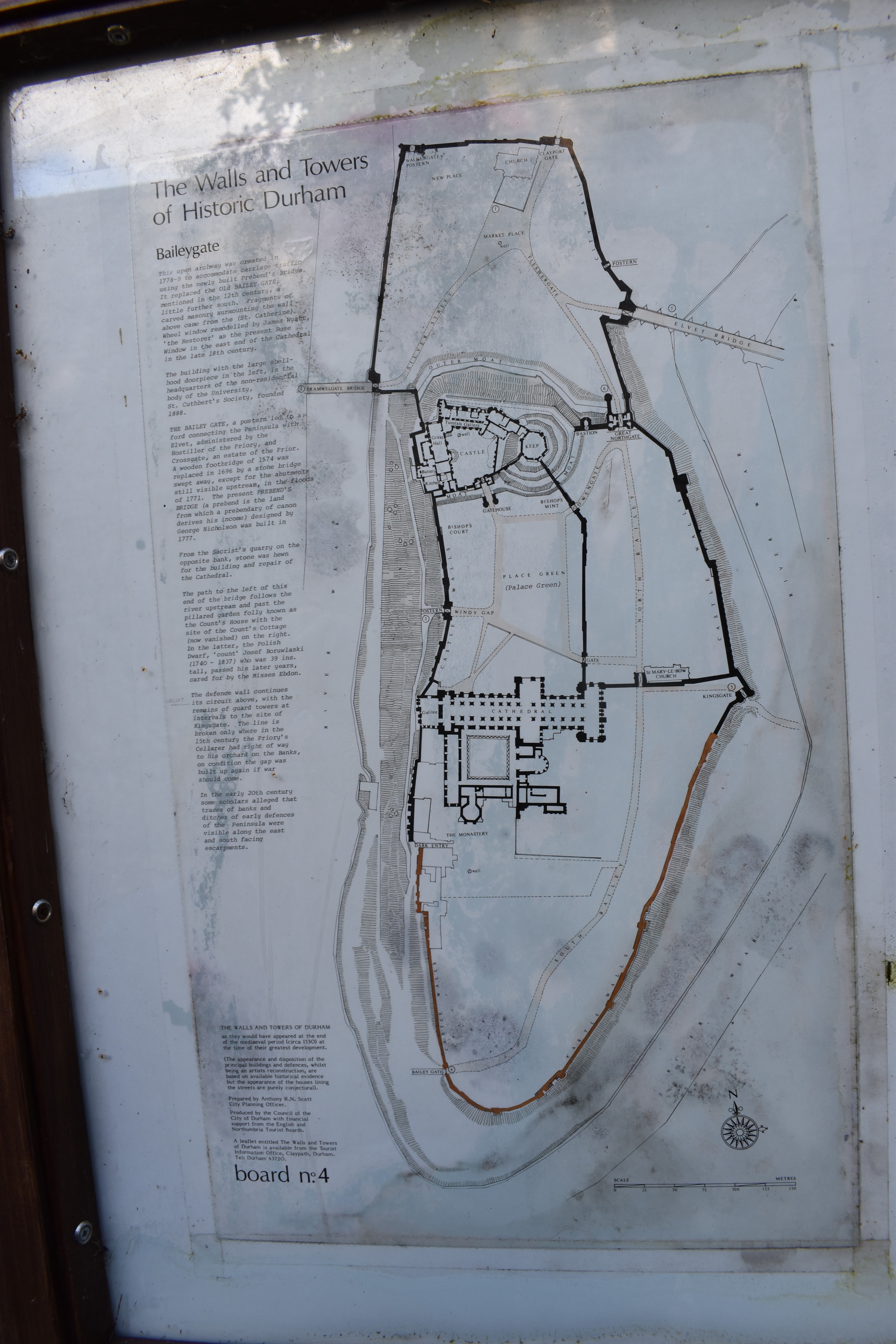
Durham, last Autumn.
Saturday, 26 February 2011
Tree Trail Again
We used a guide from the Park Rangers, which described and named the interesting trees in the park. We read what it said and then we tried to spot them. Which is all very well, but it meant we didn't look at the trees that were apparently less interesting (not important)? And having spotted them, we moved on - so sometimes we didn't look at them very hard at all, I guess. We didn't go off piste and look at trees away from the Trail, or not very much (and not always on purpose!). We stayed in the Park, and ignored interesting items outside it - like the Black Willow on the Rye, for example.
Neil used to tell us of a trip he used to organise, where (if I've got this right) he'd send groups of students out with instructions to find one or more interesting-looking trees - and find ways of describing them - and give them names. When they came back in with their descriptions, they'd all sit down with some books and see what they'd found, and what the 'official' names were, and how they were described by specialists. He said he thought the kids got to know their trees better that way, and it was more immediate, as it involved feeling the bark, squeezing leaves, looking closely at twigs and vein patterns and catkins... stuff like that.
So maybe I should have remembered Neil's approach, and we should have tackled the Tree Trail like that. On the other hand, we did enjoy it as it was (missing trees and all).
For another time, perhaps.
Wednesday, 1 December 2010
Hubris: Five in a Row
My achievement last week was far more modest - but I did at least achieve it. I solved all five of the weekday cryptic crosswords (in the Guardian). (Wow!)
Quite astonishing, for me.
I guess in part it just shows the extent to which solving crosswords is a learned skill, and is much less to do with inherent wonderfulness. I started regularly attempting the hard crosswords at the back of the paper about 2-3 years ago. And at that point, I didn't solve them - or only very, very rarely on my own. Perhaps one every 2-3 months. Instead if they did get finished it was because I collaborated with others, sharing and pinching answers.
But you improve - or I did, anyway. And I also started to become more entertained: I began to enjoy the wordgames more as I became more able to solve them. Eventually, and in a sad way, I even gave clues little exclamation marks if I thought they were particularly witty or graceful. (I'm not proud of this).
And then a few months back I realised I was solving one a week on average, and then two. Usually the easiest ones of course - which I think often occur at the start of the week. The tough ones can be really tough, for me (and I'm not discussing the Saturday prize grids here - they seem to be more variable, somehow).
Actually cryptic crosswords go back much further with me. I remember sitting in the school library in the mid-seventies, with mates who shared the same free periods, finishing an Arucaria. You remember stuff quite randomly sometimes: I remember that the last clue we solved of that puzzle was 'Begin description of dining room. (8)' (*).
So I've kind of known how the cryptic clues worked and occasionally solved them, or attempted them with friends for many years. Doug Gray, Neil Frowe.
But it is harder on your own.
A year or so ago, I also discovered the Fifteen Squared Web site (see links). I never look there beforehand, but sometimes it helped me after I'd given up to see how a particularly knotty clue worked. So, thanks to them also.
Anyway, here are the five.
Monday, 22nd November
I think it is fairly easy to see that I found this one quite straightforward. You can see I even wrote down that it only took me 40 minutes. Since I tend to try my hand at them on the train journey coming home from work, there is usually an upper limit of around an hour and a half or two hours. After which there is no time left in the day. Still, 40 minutes is not bad, even for the first grid of the week. Redcoats seemed difficult, and Audience took me a while.
Tuesday, 23rd November
I found this a little harder, and it shows - not just because it took longer (50 minutes plus), but because of the big question mark I'd left by 15 down. I did enter the solution correctly in the grid (without help, honest), but I didn't know that 'foramina' was a word meaning little openings. It just had to be the answer from the rest of the clue.
Wednesday, November 24th
This was easily the prize of the week. Amazing. A clue in French (with an answer also in French), with some Italian, German, and Latin used elsewhere.
I vaguely remembered Amoretti was a little cupid/cherub/putto (ie fat boy). Gourde was the last solution - I had no idea it was Haitian currency (settler is a stretch I think), and had to construct it from the rest of the clue. Quatre Bras was also hard, as I only had the faintest of memories of some kind of battle and had, again, to construct it. And Crucible took a while because of the brilliant misdirection.
Altogether it took me well over three hours - but I had the time as I was in town seeing someone.
I was pleased to finish it, but it had been hard. So when I looked at the comment in FifteenSquared I was pleased that many other people also said they found it tricky. It wasn't just me.
Then someone pointed out that not only was it a pangram (all of the letters), but it also, if you looked carefully, contained the French integers from Un to Neuf scattered around the grid. Amazing, indeed. (If I'd spotted that it would have made Gourde easier to solve!)
Thursday, November 25th
Again, you can see I found it really tough. Clues full of unforgiving surfaces, I thought. I went down to Southampton Uni with eldest that day, so I had the three hours+ it needed for me to complete the solution, whilst sitting on the train.
But in all honesty more than half of it came in about an hour of the journey back. I needed to make the odd correction along the way, as you can see - but more because of simple spelling errors than major mistakes. 8 down was a joy when I spotted it, but 15 across I disliked (Father Christmas as a Ho-Ho-er?)
Friday, November 26th
You have to imagine how tense I was by Friday. I was on a full house, or a hat trick, or whatever, having finished two tough crosswords during the week that would normally have defeated me. Whether that was only because I had the time for them, by chance, was neither here nor there. They were both realistically challenging. It hadn't been an easy ride.
So anyway there was this new goal, which made me try extra hard.
I think you can see that I was quite stressed by this one. With several solutions, although I worked out the answer, I couldn't get the clue to make sense (9 across was a case in point - only when I later read FifteenSquared and saw 'Bess' in 'Pub, Essex' did it seem logical to me). And I struggled for far longer than was necessary with Eclair. On the plus side, I quite liked the 'shops' theme, which I spotted early and it helped a lot.
To be honest, however, I nearly gave up right at the end with one clue left. For some reason I drew a blank on 9 down (which at other times might have proven to be pretty easy). Indeed, it only got solved when I saw, belatedly, that it formed 'John Lewis' with 16 down. Altogether, just under two hours.
But what next? Last week felt like a real achievement, but also like something completed. Something over. Time to move on? But where to? Harder crosswords? Shorter solving times? But those options partly miss the point - the pleasure and enjoyment of the wordplay. (Of course, it is also unquestionably true that I'll probably fail horribly at the next puzzle I try. Too much hubris just at the moment).
Or stop. Draw a line, and use the time released to do something different - more 'meaningful' or 'creative'?
I don't know. But I do know that this week I've gone cold turkey- no crosswords. And I'm having a think.
(* - Ans: "Initiate")
Friday, 5 February 2010
Re-imagining the Medieval
That is clearly of somewhat limited interest (others might be moved to substitute ‘no interest’); except for the fact that I sometimes feel moved to write about what I have been reading. As when, a few days ago, I commended Derek Jarman’s wonderful Modern Nature. At some point soon I will also be compelled to heap praise on Neal Stephenson’s Anathem.
Before that, however, I need to discuss a far more annoying book. The Time Traveller’s Guide to Medieval England: A Handbook for Visitors to the 14th Century (2009) by Ian Mortimer has received some very good reviews. On the front cover the critic Alison Weir calls it ‘Amazing’ while the back bristles with longer puffs from the Literary Review, the Telegraph and the Guardian – including one from the otherwise-marvellous Kathryn Hughes.
So why did I find it so annoying? Well, a little of my niggledness is caused by the extreme claims being made for his method. It is “(a) radical new approach (which) turns our entire understanding of history upside-down” according, again to the blurb. Well, no it isn’t. What the book does is perfectly OK – he tries to use historical materials (Mortimer is a professional historian) – to show what it would have been like to live in 14th Century England. His conceit is that you have travelled back in time to the period, so he can concentrate on those elements that seem truly different – those which would strike you most strongly (and which might get you into trouble if you got them wrong). He is happy to share the most unpleasant details (he begins with the idea that the stream near every village is called the Shitbrook), and some of his descriptions do seem quite vivid. But nothing more than that.
And every so often, despite quite a large apparatus of references and bibliography, he drops in a passage where his claims seem to be based on the purely imaginary.
For example, on p.247 while discussing how much quieter the medieval period is, he writes:
As a result of this comparative quiet, people listen differently. They hear with greater clarity. When a dog barks, they can recognize whose dog it is. They are more sensitive to voices. And above all else, they listen intently to music.No supporting material, no evidence. Just pure assertion. Elsewhere he seems to me to mishandle his evidence. On p.91, in a section called “Greeting People” he provides a longish quotation from a French-English dialogue book containing a number of phrases to be used in greeting people. Here is some of it:
Sire, God give you good day
….
Fellow or friend, ye be welcome
What do ye? How is it with you? Where have ye been so long?
I have been long out of the country.
In what country?
Sire that should be overmuch for to tell, but if you please, anything that I may do, command it me as to him that gladly shall I do it.
Sire, grammercy of your courteous words and of your good will.
God reward you.
For Mortimer, this is taken as true and accurate and obvious. He seems to have little sense that this dialogue:
- might be an exhortation for people to do more than they normally do on meeting,
- that if true it may be notably class-based, or
- would not be used by those who knew each other well - who would not speak like this.
All of which to me seem possibilities. He takes it at face-value, and, I think, incorrectly as a result.
But the biggest problem I have with the book is that he neglects to mention an earlier attempt to put a modern-day reader ‘into’ the medieval mindset. C.S. Lewis’s The Discarded Image: An Introduction to Medieval and Renaissance Literature – his last published book.
Admittedly, Lewis is attempting something subtly different: he is attempting to capture the medieval ‘Model’ – the ideas, beliefs and cast of mind – that seem a given to medieval writers of all kinds – and by extension to the early modern period also. Mortimer’s focus is more on lived experience and the vernacular. But they are related, I feel, and Mortimer gives no indication that he knows the Lewis. A lacunae at the very least.
Lewis’s book is also unquestionably the better. Oh, it certainly has its own weaknesses. For Lewis, it is not necessary to describe Ptolemy’s Almagest “because a French translation exists”. He can write:
Plato’s Republic, as everyone knows, ends with an account of the after-life, put into the mouth of one Er the Armenion who had returned from the dead.
As everyone knows? His ideal elite imagined audience is not the same as Mortimer’s – and it may I think have dwindled somewhat since the early sixties. But although I don’t know my Plato, I still enjoy him.
And he can be truly marvelous. Speaking of the medieval picture of the heavens he writes:
These facts are in themselves curiosities of mediocre interest. They become valuable only in so far as they enable us to enter more fully into the consciousness of our ancestors by realizing how such a universe must have affected those who believed in it. The recipe for such realisation is not the study of books. You must go out on a starry night and walk about for half an hour trying to see the sky in terms of the old cosmology. Remember that you now have an absolute Up and Down. The Earth is really the centre, really the lowest place: movement to it from whatever direction is downward movement. As a modern, you located the stars at a great distance. For distance you must now substitute that very special, and far less abstract, sort of distance which we call height; height, which speaks immediately to our muscles and nerves. The Medieval Model is vertiginous. And the fact that the height of the stars in the medieval astronomy is very small compared with their distance in the modern, will turn out not to have the kind of importance you anticipated. For thought and imagination, ten million miles and a thousand million are much the same. Both can be conceived (that is, we can do sums with both) and neither can be imagined; and the more imagination we have the better we shall know this…. Hence to look out on the night sky with modern eyes is like looking out over a sea that fades away into mist, or looking about one in a trackless forest – trees forever and no horizon. To look up at the towering medieval universe is much more like looking at a great building.
(p.98-99)
And as we find out later, one that is very much inhabited.
OK, so Lewis also makes the bold unsupported assertion; his references are scanty; he’s writing for an elite. I disagree with some of his claims. And later on in the book, towards the end, he name checks Tolkien and science fiction, I think just because he can. But he is so much more fun than Mortimer, and he really does make his period come alive.
So if you've been reading the Mortimer book with anything like pleasure, fine. But do have a look at the Discarded Image - it truly is smashing.
Friday, 1 January 2010
New Year 2010
The house smells of hyacinths. A rich and cloying smell.Six plants, brought back from Neil's wedding on the Wirral. Representing games and sports, playful joy (and rashness); also, sometimes, rebirth. Dedicated to Apollo, and named for the legend of Hyacinth.
The blue stands for constancy, the pink for recreation and playfulness, and the white loveliness ('I'll pray for you').
You gave me hyacinths first a year ago;
'They called me the hyacinth girl.'
—Yet when we came back, late, from the Hyacinth garden,
Your arms full, and your hair wet, I could not
Speak, and my eyes failed, I was neither
Living nor dead, and I knew nothing,
Looking into the heart of light, the silence.
Od' und leer das Meer.
(The Waste Land)
Outside it is the first day of a new year and a new decade, 2010. Cold and sunny; clear blue skies over the Rye.
A random set of words and phrases characterising 2009 might include: Credit Crunch, Recession, Michael Jackson, iPhone, Twitter, Obama, swine flu, Large Hadron Collider, Boyle, Callow, Climate Change, J.G. Ballard, Woolworths, Claude Levi-Strauss, Afghanistan, Iraq, Plinth, Lumley and Gurkas, BNP, Expenses and Duck House.
But these are only the big public things.
I could produce a list - and of course, a more meaningful one for me - around the smaller-scale things:- school exams, juggling notation, various books I've read, crosswords, braces, concerts, the Christmas Lectures, the Picos and Madness.
And for a similar view of the decade? Well, for the majority of the time, I worked at the British Museum, and it feels strange that at the start of 2000 the Great Court was still under construction, and Suzanna Taverne was MD.
It finally opened on December 7th 2000, with a big event - I ended up sharing a table with the Bottomleys, amongst others. She of 'I'm an evil Tory bigot' fame - and he was just creepy.Also at the Museum, the Virtual Mummy was cool and Terracotta Army amazing.
But it was also a decade in which the children grew big (bigger), we acquired a new kitchen, the sheen on the Labour Government wore off and my 50th happened at me. Shucks. A slew of holidays and parties.
New year 2000 was spent in the upper part of Telegraph Hill park, watching Mayor Ken's "River of Fire" fireworks spread from Tower Bridge to the London Eye; from where we stood (and possibly from nowhere else) it looked good and seemed to work.
Looking wider and less personally - 9/11 in 2001 obviously, and the bombs in Madrid, and 7/7 in London, 2005. And Ken's moving speech from China, where he had been helping to win the Olympic Games for London (Paris? Pah!). The Google beta launched in early 2000. Foot and Mouth arrived in 2001. G W Bush elected in 2001 (hanging chads, remember?), Dr Who returned and was spiffy, the code for the human genome was cracked. Horrible Boris whiff-whaff became Mayor of London. Planets were discovered orbiting other stars, and Pluto was downgraded. The Tsunami in 2004, and hurricane Katrina. The Euro. Columbia disaster. Kyoto. The Lord of the Rings films were just about good enoughI can recall sitting down to watch the first of the trilogy with eldest at the cinema in Peckham; we'd just finished reading the books together. Just a few seconds in a large man leaned over and told me, in no uncertain terms, to stop making so much noise eating the popcorn we'd just bought. He clearly cared so much, and wanted the experience of the film ('...at last they've made it!') to be so perfect, that he couldn't take any little imperfection. Like me crunching popcorn in the background. This was Important.
I felt something similar about the Dr Who relaunch. But I didn't just want it to be great, I wanted the children to like it also - which they did of course, but I can remember being somewhat tense as the music started up ('Yes! they've kept the music! It's all going to be OK after all...') .
Too much perfection, or too much desire for it, is a very dangerous thing...