Pobcebos and Bulnes aren’t really that far from
Potes, but there are mountains in the way. So we had to drive North (back through the
Gorge again), then West, then South to get there.
The chief reason for including this picture, taken in the Gorge, is as a reminder of the speedy, scary Spanish drivers up in those parts, and their careful lane discipline...
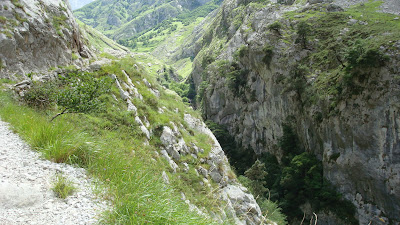
 Finally we reached the southern leg of the journey, along the A264 (Carretara de Poncebos), through the Cares gorge. If anything, these mountains seemed even more stark and rugged than the ones we had left in the Eastern Picos.

 At Poncebos is the entrance to a most unlikely construction. The Funicular de Bulnes. Bulnes is the only town in Asturias - apparently- with no road access. So before 2001 the only way to reach it from Poncebos was to take the steep, narrow, winding track by foot or donkey.
However, with significant EU funding the mindbending decision had been made to bore a tunnel 2.23 km long, rising around 400m, to carry a small funicular railway between one and the other. The journey takes 7 minutes, the inclination is 18%, the car takes up to 28 passengers, there is a van for goods as well (if wanted) - it really is a marvel. And the residents of Bulnes go for free.
But what astonishes me is that it was built at all. The decision wasn't uncontroversial, and from the OJEC records, there seem to have been some serious questions:
Work has begun on the funicular railway which will provide access to Bulnes, despite the fact that appeals havebeen lodged and that the work has not even been approved (as is legally required) by those responsible forrunning the national park. This irregularity was pointed out by the Environment Ministry in a document of6 November which was signed by the head of the national parks division and which points out to the AsturiasRegional Government that there are irregularities in the project.
In specific terms, three irregularities are mentioned:
− The works project should have been the subject of a prior report by the park management.
− The plan (PLAN) made available for public consultation does not correspond to the one ultimately put intoeffect by the body promoting the funicular railway.
− The lack of legal backing for the project in its attempts to circumvent what is laid down in the Picos deEuropa natural resources plan.
Many environmental bodies which have appealed against the Bulnes funicular railway maintain that thedocument from the Environment Ministry justifies their claims.(Written Question to the Commission at OJEC (98/C 323/71) - answered on the following page)
Well, it's there now - surreal as that may be - so the youngest and I decided to have a go.
 Its long, very long, and seems incredibly steep. Some of the effects from inside the car are quite spectacular.


 At the top, after leaving the funicular, you seem deep in the mountains. A path leads away along reasonably level ground to the pueblo of Bulnes.


 We stopped at Bulnes for a snack. The village is very touristy, with lots of cafes and places to take refreshment. While we were there it seemed crowded, but that may just be because a group of teenage International Scouts had stopped a little way outside the village - and they seemed to be everywhere. Large numbers of walkers and climbers also come to this part of the Picos.
While we were there we finally witnessed and heard the harsh sounds of the Asturian bagpipes.  I really enjoyed them - youngest was less sure. (Actually he was very sure - he said he thought they were horrid).
We waited a while, wandering around the village, and then finally met up with the others who had come up by the donkey-path. They certainly looked as if they'd had sufficient exercise!
This is the upper entrance to the funicular. We all took the railway down...

... and here I managed to catch a picture of the two cars passing at the mid-point - where the single track railway suddenly blossoms into a passing place.

However, given that two members of the household took the trouble to climb up the hard way, it seems only reasonable to end with a few of their photographs: