Showing posts with label art history. Show all posts

Tuesday, 26 August 2025

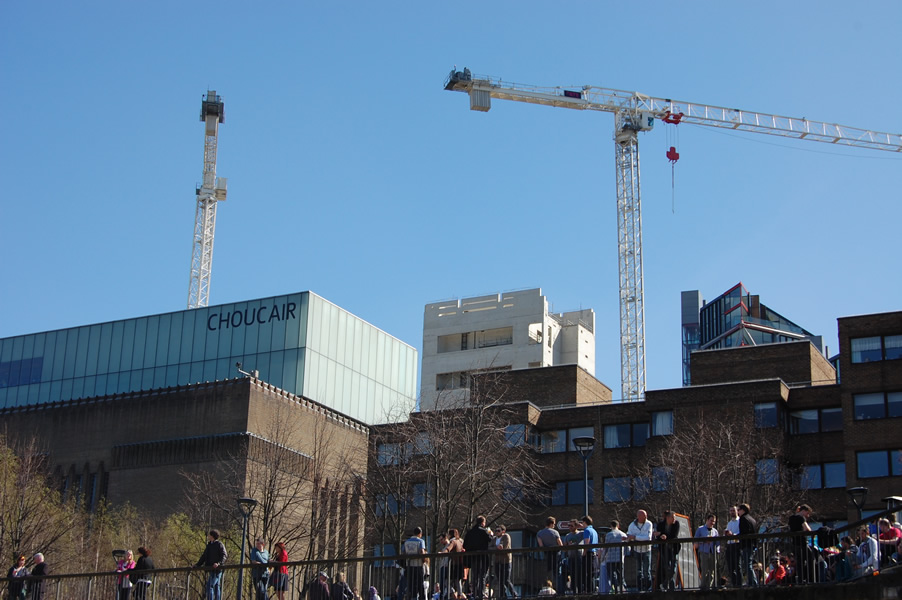
Trees on Tour: Around Trafalgar Square

A couple of months ago...


Wednesday, 4 June 2025

Vetinari at the National Gallery...


 He is in disguise as Don Justino de Neve. 1665. By Bartolome Esteban Murillo.

Tuesday, 13 June 2023

After Impressionism

Last week to the big National Gallery exhibition, After Impressionism: Inventing Modern Art.  That title itself may indicate some of the problems with the show (at least to the mind of the Trees).

Probably originally intended as a follow-up to the 2015 Inventing Impressionism, this new show covers the period roughly from 1886 - and the last of the Impressionist Exhibitions - to the outbreak of the First World War.

And it is annoying.

It presents a rather old-fashioned idea of art-historical development, which has been seriously challenged in recent years.  And it leaves out most of the women.

Rather than go on a long rant about it, we at the Trees would direct readers to this rather good Guardian critique of the show, by Eliza Goodpasture.

Elsewhere, of course, the paper has a more friendly review of the exhibition.  But for us, the Goodpasture piece broadly says what needs to be said.

And yet.  We kind of think you should go and see it if you can.  

Ignore the narrative, which as noted is a bit rubbish.  But the art is pretty damn good.


Wednesday, 28 April 2021

Sadly, the End of the Bell Epoque


A few years ago, I really enjoyed writing a master’s dissertation on Steve Bell’s ‘If…’ cartoons from the Falklands War. 

In addition to the blunt truths he spoke to power, what struck me then was extent to which he reused carefully-chosen references from popular and high culture to make his points.  The very first Falklands strip, as well as introducing us to Reg Kipling, was composed and drawn in the style of jingoistic boy’s war comics from the fifties and sixties.  In a few brief panels this effectively skewered the rhetoric of the pro-war commentators of the time.

He's continued to deploy such intertextual references, using deceptively fine draughtsmanship to evoke other works in his  political commentary.  

His rumbunctious collection of infeasible animals (penguins with teeth?) echo the Beano and the Dandy, of course.  And equally pleasing is his reuse of more establishment artworks, as recently when he presented the naked condom Cameron in full Greensill lobby mode, in a version of Manet’s ‘Le Déjeuner sur l'Herbe’.

If this truly is the end of ‘If…’, the Guardian will be the poorer for it, but we should at least thank Monsieur l’Artiste for all of the rich pleasures he has given us over the years. 

And perhaps his most appropriate legacy will be if future cartoonists look back at Steve’s work, (in my view the great political cartoons of our time), and re-use John the Monkey, Harry Hardnose, and of course Prince Philip the Greek Penguin in their own attempts to challenge the next gang of charlatans that manages to win power, to similarly take the royal piss out of those who lord it over us. 

(With due credit of course).


Saturday, 31 August 2013

Tour: Foster

Opposite the Temple in Nimes, the Maison Carrée, is a gallery given over to contemporary art, the Carré d'Art.
As can easily be seen, the gallery has been designed (by Norman Foster) as Architecture with a capital A, intending to echo the Roman temple opposite.And as the modest poster indicates, they were mounting a retrospective on Foster's architecture and Art (another big A) while we were there.

We didn't like the building.   To us it came across as the worst kind of sub-modernism; rather old-fashioned in the same way that a 1960s municipal civic centre is now old-fashioned.  Lots of glass and concrete and cantilevered stairs over voids.  A focus on Spaces (capital S) but with little real joy.  We would hate to work there.

This wasn't the only Foster gallery we encountered on the Tour.  We also visited the Museum of Prehistory of the Gorges du Verdun, in Quinson.  This had the great virtue of having real content, of course.

However, and again, the much vaunted Foster architecture, all sweeping concrete curved walls, did little for us at TANH.  It reminded us of some of those parts of Foster's Great Court, in the British Museum, that are somewhat behind the scenes and less-commonly seen.  The Education Centre in the basement beneath the main courtyard, for example, has the same love of roughened concrete and transitioning curves.  Exciting in theory perhaps, but cold and inhuman in practice.

The weekend before the Great Court was due to be opened by the Queen, we were working on some final IT stuff, and spotted some of the Foster's staff on one of the balconies.  They got some workmen together, and set them to work breaking up the stone slabs in front of the Reading Room.  They were quickly stopped by Museum senior management of course, before too much damage was done, but some slabs were broken and had to be replaced.

Their reasons were aesthetic, and about the look of things: the slabs they wanted to remove were a slightly different colour from the others, and they needed replacing with stone which was a better match.  The offending slabs were damaged, of course, before the workmen were stopped, so we suspect they got their way.  Apocryphally, we heard that the underflow heating and ducting systems were also damaged and never repaired, as a result of the designers focus on surfaces, but we don't know the truth of that.

It did amuse us, however, to see this just outside Foster's Carré d'Art:
Maybe it has become his new signature?  Along with the brutalist concrete, that is...

Finally, one other apocryphal story.
We heard that when the Chairman of the British Museum (a pompous title for a pompous man at that time) attempted to enter the British Museum for the grand opening of the Great Court by the Queen, with the then Sir Norman Foster, the latter was stopped by the gate guard.

'Do you know who this is?', asked the Chairman.
'Yes', came the reply. 'But he can't come in without a pass.  Temporary passes round the back, tradesmen's entrance.'
'But he's with me!'
'Temporary passes round the back, tradesmen's entrance. But you can come in, sir, you've got your pass.'

So the Chairman rang the duty security manager and complained about the 'jobsworth on the gate'.

'Sorry sir, but he's right.  He's doing his job. Temporary passes round the back, tradesmen's entrance.'
'But he's the architect of the whole scheme!'
'Exactly, sir.  Just a supplier.  Not even a member of staff. Temporary passes round the back, tradesmen's entrance.'

So Sir Norman went round the back to the tradesmen's entrance, and got a temporary pass.

And a couple of people from the Security team got bought free drinks on the strength of the story for weeks afterwards.....

Monday, 29 April 2013

Pumping Bellows

We went to the Manet Exhibition last month at the Royal Academy. Now, it wasn't bad, but I have to say I don't think it justified the hype.  There were one or two really great portraits - like the Berthe Morrisot that was (over) used to advertise the show.  But overall there were too many not-quite-good-enough works, of dour-looking men in suits, that didn't excite.  And because of the hype it was too crowded.

And then we went upstairs to the George Bellows - which is a show that is still on, and almost empty when we went. Smaller, focussed and much, much more wonderful.  Almost all of the works you'd want to see are there, hanging up high in the Sackler Gallery, floating above the sour, dour Manets.  The colour, composition and narrative excitement of these paintings are a wonder.  I'm so pleased to have had the chance to see them.

My only reservation is a sense that the RA is a bit hesitant about the show.  It isn't that well advertised;  people seem surprised when you tell them about it.  There is only one large poster on sale associated with the event - although, admittedly, a ravishing New York street scene and landscape, it is not enough.

Anyway I bought it of course, and took to the Thames Gallery on the East Dulwich Road to get framed.  They loved it when I took it in.

And then, when I picked it up they said that two more had come in for framing... do I detect a small South London Bellows Burn? 
(PS: This is a different landscape... I'd love a print of it  *hint*)

Sunday, 21 April 2013

On the South Bank of the Thames, in the Cold Spring Sunshine

After a visit to Tate Modern, which surprisingly wasn't irredeemably awful (they've reorganised their stuff since I was last there, so that it makes a little more sense, including putting some of the things I don't hate in the same spaces - like a gallery on 'Realisms' which chimes with Christine Lindey's course on The Alternative Tradition, a little), I came out into the Spring sunshine to see these two  chaps eating fire and juggling:
Which was quite fun. 

I then did something I rarely do: the tide was out, so I went down to the beach; the real South Bank of the Thames, if you will.
The Shard seems small and unimportant from this angle, compared with the expanse of the River and the rest of London.  And there is a wealth of stuff down at water level you don't see from up on the embankment.
And of course, the River itself is closer.
...while the bridges are... up there.
The red piers from the old, 1864 Blackfriars Bridge are especially impressive from the waterline.
While the Millennium Footbridge (no longer so bouncy) was very busy on the day...
And finally, just like almost every other cultural barn in London in the last ten years, Tate Modern is getting a new bit built...

Thursday, 11 October 2012

Bank Manager up on the Wall

Well, after its Fitting, the print of a Flying Machine to Escape the Bank Manager finally is on my office wall.

It arrived, was unwrapped, carted in to work, and now there it is...

Of course, it is hard to see the scale like that - so here it is parked on a comfy chair...

Monday, 14 May 2012

All about Browning

In recognition of Browning’s recent Bicentenary, as keen observers of TANH will have spotted, I posted a few of his poems. And I’m a bit of a Browning fan, so I wanted to show him off a little, to choose poems that would explain my enthusiasm.

This was really quite hard. Rather, I guess, like choosing the tracks to be your Desert Island Discs. What to include, and what to leave out, and why?

First off, I’d already plastered a few Browning’s over TANH as part of the Poem of the Week strand. In particular:-
And I also mentioned him in passing, in an essay on Tennyson, in 2009 and also discussed a radio programme about My Last Duchess.

So what to choose for the centenary?  Well, one of the great pleasures of Browning is his range, and the first thing I noticed was that I hadn't posted any of the love lyrics or shorter poems previously.  So I began with one of my favourite lyrics, Love Among the Ruins, with its unusual patterning of rhythm.
 
And by far the most famous of theshort poems is Home Thoughts from Abroad of course, with it's opening of "Oh, to be in England/Now that April's there" - so that seemed to be a cert.
 
Then, given that I was thinking about his most famous poetry, "The Pied Piper of Hamelin" had to be there with its wonderful:
Rats!

They fought the dogs and killed the cats,
And bit the babies in the cradles,
And ate the cheeses out of the vats,
And licked the soup from the cook’s own ladles,
Split open the kegs of salted sprats,
Made nests inside men’s Sunday hats,
And even spoiled the women’s chats
By drowning their speaking
With shrieking and squeaking
In fifty different sharps and flats.
After which why Garden Fancies II: Sindandus Schafnaburgensis? Partly, I will admit, a desire for some suitably 'crabbed' Browning but also because I love:
How did he like it when the live creatures
Tickled and toused and browsed him all over,
And worm, slug, eft, with serious features,
Came in, each one, for his right of trover?
---When the water-beetle with great blind deaf face
Made of her eggs the stately deposit,
And the newt borrowed just so much of the preface
As tiled in the top of his black wife's closet?
After which a more direct short poem again seemed in order - so I chose the "the quick sharp scratch/And blue spurt of a lighted match from "Meeting at Night"

By now I'd covered a lot of ground, but still hadn't touched upon one of Browning's great topics, the great painter and scupltors of renaissance Italy.  Hence Andrea del Sarto - called by some "the faultless painter" - which many critics have thought Browning's greatest poem.  I can see it is great, but to be honest it isn't even my favourite Browning poem about renaissance Italian painters! (*)

So in keeping with the plan of keeping things diverse, it was back to the short love lyric and Summum Bonum. 

Perhaps the most anthologised of Browning's poems (after the Pied Piper, of course) is My Last Duchess - and one of my great pleasures.  So I couldn't leave that out.

(")  And I had to have my favourite poem about a renaissance Italian painter, Fra Lippo Lippi.  Browning keeps close to Vasari.  The latter tells us 
Cosimo therefore, when he was working for him in his house, caused him to be shut in, so that he could not go out and waste his time; but he, cutting up the sheets of the bed with a pair of scissors, made a rope and let himself down by the window...
Which in Browning's poem becomes:
— three slim shapes,

And a face that looked up . . . zooks, sir, flesh and blood,
That's all I'm made of! Into shreds it went,
Curtain and counterpane and coverlet,
All the bed-furniture — a dozen knots,
There was a ladder! Down I let myself,
Hands and feet, scrambling somehow, and so dropped,
And after them. I came up with the fun
Less well-known, but also interesting, is House - with some echoes of Keats and Tennyson, in very different ways.

Eventually everything comes to an end of course, but I had to leave so much out! 

Pictor Ignotus;
An Epistle Containing the Strange Medical Experience of Karshish, the Arab Physician;
Mr Sludge, the Medium;
How they Brought the Good News from Ghent to Aix (honest!);
Rabbi Ben Ezra (Grow old along with me/The best is yet to be/The last of life/For which the first was made)
Soliloquy of the Spanish Cloister;
By the Fireside;
The Bishop Orders His Tomb at Saint Praxed's Church;
A Toccata of Galuppi's;
Caliban Upon Setebos;
Tray;
The Laboratory
 
Anyway, go read.  It's an order.

Fra Lippo Lippi

Fra Lippo Lippi
Robert Browning

[Florentine painter, 1412-69]

I am poor brother Lippo, by your leave!
You need not clap your torches to my face.
Zooks, what's to blame? you think you see a monk!
What, 'tis past midnight, and you go the rounds,
And here you catch me at an alley's end
Where sportive ladies leave their doors ajar?
The Carmine's my cloister: hunt it up,
Do — harry out, if you must show your zeal,
Whatever rat, there, haps on his wrong hole,
And nip each softling of a wee white mouse,
, , that's crept to keep him company!
Aha, you know your betters! Then, you'll take
Your hand away that's fiddling on my throat,
And please to know me likewise. Who am I?
Why, one, sir, who is lodging with a friend
Three streets off — he's a certain . . . how d'ye call?
Master — a . . . Cosimo of the Medici,
I' the house that caps the corner. Boh! you were best!
Remember and tell me, the day you're hanged,
How you affected such a gullet's-gripe!
But you, sir, it concerns you that your knaves
Pick up a manner nor discredit you:
Zooks, are we pilchards, that they sweep the streets
And count fair prize what comes into their net?
He's Judas to a tittle, that man is!
Just such a face! Why, sir, you make amends.
Lord, I'm not angry! Bid your hangdogs go
Drink out this quarter-florin to the health
Of the munificent House that harbors me
(And many more beside, lads! more beside!)
And all's come square again. I'd like his face —
His, elbowing on his comrade in the door
With the pike and lantern — for the slave that holds
John Baptist's head a-dangle by the hair
With one hand ("Look you, now," as who should say)
And his weapon in the other, yet unwiped!
It's not your chance to have a bit of chalk,
A wood-coal or the like? or you should see!
Yes, I'm the painter, since you style me so.
What, brother Lippo's doings, up and down,
You know them and they take you? like enough!
I saw the proper twinkle in your eye —
'Tell you, I liked your looks at very first.
Let's sit and set things straight now, hip to haunch.
Here's spring come, and the nights one makes up bands
To roam the town and sing out carnival,
And I've been three weeks shut within my mew,
A-painting for the great man, saints and saints
And saints again. I could not paint all night —
Ouf! I leaned out of window for fresh air.
There came a hurry of feet and little feet,
A sweep of lute-strings, laughs, and whifts of song —
Flower o' the broom,
Take away love, and our earth is a tomb!
Flower o' the quince,
I let Lisa go, and what good is life since?
Flower o' the thyme> — and so on. Round they went.
Scarce had they turned the corner when a titter
Like the skipping of rabbits by moonlight — three slim shapes,
And a face that looked up . . . zooks, sir, flesh and blood,
That's all I'm made of! Into shreds it went,
Curtain and counterpane and coverlet,
All the bed-furniture — a dozen knots,
There was a ladder! Down I let myself,
Hands and feet, scrambling somehow, and so dropped,
And after them. I came up with the fun
Hard by Saint Laurence, hail fellow, well met —
If I've been merry, what matter who knows?hy
And so as I was stealing back again
To get to bed and have a bit of sleep
Ere I rise up to-morrow and go work
On Jerome knocking at his poor old breast
With his great round stone to subdue the flesh,
You snap me of the sudden. Ah, I see!
Though your eye twinkles still, you shake your head —
Mine's shaved — a monk, you say — the sting's in that!
If Master Cosimo announced himself,
Mum's the word naturally; but a monk!
Come, what am I a beast for? tell us, now!
I was a baby when my mother died
And father died and left me in the street.
I starved there. God knows how, a year or two
On fig-skins, melon-parings, rinds and shucks,
Refuse and rubbish. One fine frosty day,
My stomach being empty as your hat,
The wind doubled me up and down I went.
Old Aunt Lapaccia trussed me with one hand,
(Its fellow was a stinger as I knew)
And so along the wall, over the bridge,
By the straight cut to the convent. Six words there,
While I stood munching my first bread that month:
"So, boy, you're minded," quoth the good fat father
Wiping his own mouth, 't was refection-time —
"To quit this very miserable world?
Will you renounce" . . . "the mouthful of bread?" thought I;
By no means! Brief, they made a monk of me;
I did renounce the world, its pride and greed,
Palace, farm, villa, shop and banking-house,
Trash, such as these poor devils of Medici
Have given their hearts to — all at eight years old.
Well, sir, I found in time, you may be sure,
'T was not for nothing — the good bellyful,
The warm serge and the rope that goes all round,
And day-long blessed idleness beside!
"Let's see what the urchin's fit for" — that came next,
Not overmuch their way, I must confess.
Such a to-do! They tried me with their books:
Lord, they'd have taught me Latin in pure waste!
Flower o' the clove,
All the Latin I construe is, "amo" I love!
But, mind you, when a boy starves in the streets
Eight years together, as my fortune was,
Watching folk's faces to know who will fling
The bit of half-stripped grape-bunch he desires,
And who will curse or kick him for his pains,
Which gentleman processional and fine,
Holding a candle to the Sacrament,
Will wink and let him lift a plate and catch
The droppings of the wax to sell again,
Or holla for the Eight and have him whipped,
How say I? — nay, which dog bites?, which lets drop
His bone from the heap of offal in the street —
Why, soul and sense of him grow sharp alike,
He learns the look of things, and none the less
For admonition from the hunger-pinch.
I had a store of such remarks, be sure,
Which, after I found leisure, turned to use.
I drew men's faces on my copy-books,
Scrawled them within the antiphonary's marge,
Joined legs and arms to the long music-notes,
Found eyes and nose and chin for A's and B's,
And made a string of pictures of the world
Betwixt the ins and outs of verb and noun,
On the wall, the bench, the door. The monks looked black.
"Nay," quoth the Prior, "turn him out, d' ye say?
In no wise. Lose a crow and catch a lark.
What if at last we get our man of parts,
We Carmelites, like those Camaldolese
And Preaching Friars, to do our church up fine
And put the front on it that ought to be!"
And hereupon he bade me daub away.
Thank you! my head being crammed, the walls a blank,
Never was such prompt disemburdening.
First, every sort of monk, the black and white,
I drew them, fat and lean : then, folk at church,
From good old gossips waiting to confess
Their cribs of barrel-droppings, candle-ends —
To the breathless fellow at the altar-foot,
Fresh from his murder, safe and sitting there
With the little children round him in a row
Of admiration, half for his beard and half
For that white anger of his victim's son
Shaking a fist at him with one fierce arm,
Signing himself with the other because of Christ
(Whose sad face on the cross sees only this
After the passion of a thousand years)
Till some poor girl, her apron o'er her head,
(Which the intense eyes looked through) came at eve
On tiptoe, said a word, dropped in a loaf,
Her pair of earrings and a bunch of flowers
(The brute took growling), prayed, and so was gone,
I painted all, then cried "'T is ask and have;
Choose, for more's ready!" — laid the ladder flat,
And showed my covered bit of cloister-wall.
The monks closed in a circle and praised loud
Till checked, taught what to see and not to see,
Being simple bodies — "That's the very man!
Look at the boy who stoops to pat the dog!
That woman's like the Prior's niece who comes
To care about his asthma: it's the life!"
But there my triumph's straw-fire flared and funked;
Their betters took their turn to see and say:
The Prior and the learned pulled a face
And stopped all that in no time. "How? what's here?
Quite from the mark of painting, bless us all!
Faces, arms, legs and bodies like the true
As much as pea and pea! it's devil's-game!
Your business is not to catch men with show,
With homage to the perishable clay,
But lift them over it, ignore it all,
Make them forget there's such a thing as flesh.
Your business is to paint the souls of men —
Man's soul, and it's a fire, smoke . . . no, it's not . . .
It's vapor done up like a new-born babe —
(In that shape when you die it leaves your mouth)
It's . . . well, what matters talking, it's the soul!
Give us no more of body than shows soul!
Here's Giotto, with his Saint a-praising God,
That sets us praising — why not stop with him?
Why put all thoughts of praise out of our head
With wonder at lines, colors, and what not?
Paint the soul, never mind the legs and arms!
Rub all out, try at it a second time.
Oh, that white smallish female with the breasts,
She's just my niece . . . Herodias, I would say —
Who went and danced and got men's heads cut off!
Have it all out! "Now, is this sense, I ask?
A fine way to paint soul, by painting body
So ill, the eye can't stop there, must go further
And can't fare worse! Thus, yellow does for white
When what you put for yellow's simply black,
And any sort of meaning looks intense
When all beside itself means and looks naught.
Why can't a painter lift each foot in turn,
Left foot and right foot, go a double step,
Make his flesh liker and his soul more like,
Both in their order? Take the prettiest face,
The Prior's niece . . . patron-saint — is it so pretty
You can't discover if it means hope, fear,
Sorrow or joy? won't beauty go with these?
Suppose I've made her eyes all right and blue,
Can't I take breath and try to add life's flash,
And then add soul and heighten them three-fold?
Or say there's beauty with no soul at all —
(I never saw it — put the case the same — )
If you get simple beauty and naught else,
You get about the best thing God invents:
That's somewhat: and you'll find the soul you have missed,
Within yourself, when you return him thanks.
"Rub all out! "Well, well, there's my life, in short,
And so the thing has gone on ever since.
I'm grown a man no doubt, I've broken bounds:
You should not take a fellow eight years old
And make him swear to never kiss the girls.
I'm my own master, paint now as I please —
Having a friend, you see, in the Corner-house!
Lord, it's fast holding by the rings in front —
Those great rings serve more purposes than just
To plant a flag in, or tie up a horse!
And yet the old schooling sticks, the old grave eyes
Are peeping o'er my shoulder as I work,
The heads shake still — "It's art's decline, my son!
You're not of the true painters, great and old;
Brother Angelico's the man, you'll find;
Brother Lorenzo stands his single peer:
Fag on at flesh, you'll never make the third!"
You keep your mistr . . . manners, and I'll stick to mine!
I'm not the third, then: bless us, they must know!
Don't you think they're the likeliest to know,
They with their Latin? So, I swallow my rage,
Clench my teeth, suck my lips in tight, and paint
To please them — sometimes do and sometimes don't;
For, doing most, there's pretty sure to come
A turn, some warm eve finds me at my saints —
A laugh, a cry, the business of the world —
Flower o' the peach,
Death for us all, and his own life for each!
And my whole soul revolves, the cup runs over,
The world and life's too big to pass for a dream,
And I do these wild things in sheer despite,
And play the fooleries you catch me at,
In pure rage! The old mill-horse, out at grass
After hard years, throws up his stiff heels so,
Although the miller does not preach to him
The only good of grass is to make chaff.
What would men have? Do they like grass or no —
May they or may n't they? all I want's the thing
Settled forever one way. As it is,
You tell too many lies and hurt yourself:
You don't like what you only like too much,
You do like what, if given you at your word,
You find abundantly detestable.
For me, I think I speak as I was taught;
I always see the garden and God there
A-making man's wife: and, my lesson learned,
The value and significance of flesh,
I can't unlearn ten minutes afterwards,

You understand me: I'm a beast, I know.
But see, now — why, I see as certainly
As that the morning-star's about to shine,
What will hap some day. We've a youngster here
Comes to our convent, studies what I do,
Slouches and stares and lets no atom drop:
His name is Guidi — he'll not mind the monks —
They call him Hulking Tom, he lets them talk —
He picks my practice up — he'll paint apace,
I hope so — though I never live so long,
I know what's sure to follow. You be judge!
You speak no Latin more than I, belike;
However, you're my man, you've seen the world
— The beauty and the wonder and the power,
The shapes of things, their colors, lights and shades,
Changes, surprises, — and God made it all!
— For what? Do you feel thankful, ay or no,
For this fair town's face, yonder river's line,
The mountain round it and the sky above,
Much more the figures of man, woman, child,
These are the frame to? What's it all about?
To be passed over, despised? or dwelt upon,
Wondered at? oh, this last of course! — you say.
But why not do as well as say — paint these
Just as they are, careless what comes of it?
God's works — paint any one, and count it crime
To let a truth slip. Don't object, "His works
Are here already; nature is complete:
Suppose you reproduce her (which you can't)
There's no advantage! you must beat her, then."
For, don't you mark? we're made so that we love
First when we see them painted, things we have passed
Perhaps a hundred times nor cared to see;
And so they are better, painted — better to us,
Which is the same thing. Art was given for that;
God uses us to help each other so,
Lending our minds out. Have you noticed, now,
Your cullion's hanging face? A bit of chalk,
And trust me but you should, though! How much more,
If I drew higher things with the same truth!
That were to take the Prior's pulpit-place,
Interpret God to all of you! Oh, oh,
It makes me mad to see what men shall do
And we in our graves! This world's no blot for us,
Nor blank; it means intensely, and means good:
To find its meaning is my meat and drink.
"Ay, but you don't so instigate to prayer!"
Strikes in the Prior: "when your meaning's plain
It does not say to folk — remember matins,
Or, mind you fast next Friday! "Why, for this
What need of art at all? A skull and bones,
Two bits of stick nailed crosswise, or, what's best,
A bell to chime the hour with, does as well.
I painted a Saint Laurence six months since
At Prato, splashed the fresco in fine style:
" How looks my painting, now the scaffold's down?"
I ask a brother: "Hugely," he returns —
"Already not one phiz of your three slaves
Who turn the Deacon off his toasted side,
But's scratched and prodded to our heart's content,
The pious people have so eased their own
With coming to say prayers there in a rage:
We get on fast to see the bricks beneath.
Expect another job this time next year,
For pity and religion grow i' the crowd —
Your painting serves its purpose! Hang the fools!

— That is — you'll not mistake an idle word
Spoke in a huff by a poor monk. God wot,
Tasting the air this spicy night which turns
The unaccustomed head like Chianti wine!
Oh, the church knows! don't misreport me, now!
It's natural a poor monk out of bounds
Should have his apt word to excuse himself:
And hearken how I plot to make amends.
I have bethought me: I shall paint a piece
. . . There's for you! Give me six months, then go, see
Something in Sant' Ambrogio's! Bless the nuns!
They want a cast o' my office. I shall paint
God in the midst. Madonna and her babe,
Ringed by a bowery flowery angel-brood,
Lilies and vestments and white faces, sweet
As puff on puff of grated orris-root
When ladies crowd to Church at midsummer.
And then i' the front, of course a saint or two —
Saint John, because he saves the Florentines,
Saint Ambrose, who puts down in black and white
The convent's friends and gives them a long day,
And Job, I must have him there past mistake,
The man of Uz (and Us without the z,
Painters who need his patience). Well, all these
Secured at their devotion, up shall come
Out of a corner when you least expect,
As one by a dark stair into a great light,
Music and talking, who but Lippo! I! —
Mazed, motionless and moonstruck — I'm the man!
Back I shrink — what is this I see and hear?
I, caught up with my monk's-things by mistake,
My old serge gown and rope that goes all round,
I, in this presence, this pure company!
Where's a hole, where's a corner for escape?
Then steps a sweet angelic slip of a thing
Forward, puts out a soft palm — "Not so fast!"
— Addresses the celestial presence, "nay —
He made you and devised you, after all,
Though he's none of you! Could Saint John there draw —
His camel-hair make up a painting-brush?
We come to brother Lippo for all that,
"Iste perfecit opus." So, all smile —
I shuffle sideways with my blushing face
Under the cover of a hundred wings
Thrown like a spread of kirtles when you're gay
And play hot cockles, all the doors being shut,
Till, wholly unexpected, in there pops
The hothead husband! Thus I scuttle off
To some safe bench behind, not letting go
The palm of her, the little lily thing
That spoke the good word for me in the nick,
Like the Prior's niece . . . Saint Lucy, I would say.
And so all's saved for me, and for the church
A pretty picture gained. Go, six months hence!
Your hand, sir, and good-bye: no lights, no lights!
The street's hushed, and I know my own way back,
Don't fear me! There's the gray beginning. Zooks!

Friday, 11 May 2012

Great Browning

Andrea del Sarto
Robert Browning

But do not let us quarrel any more,
No, my Lucrezia; bear with me for once:
Sit down and all shall happen as you wish.
You turn your face, but does it bring your heart?
I'll work then for your friend's friend, never fear,
Treat his own subject after his own way,
Fix his own time, accept too his own price,
And shut the money into this small hand
When next it takes mine. Will it? tenderly?
Oh, I'll content him,—but to-morrow, Love!
I often am much wearier than you think,
This evening more than usual, and it seems
As if—forgive now—should you let me sit
Here by the window with your hand in mine
And look a half-hour forth on Fiesole,
Both of one mind, as married people use,
Quietly, quietly the evening through,
I might get up to-morrow to my work
Cheerful and fresh as ever. Let us try.
To-morrow, how you shall be glad for this!
Your soft hand is a woman of itself,
And mine the man's bared breast she curls inside.
Don't count the time lost, neither; you must serve
For each of the five pictures we require:
It saves a model. So! keep looking so—
My serpentining beauty, rounds on rounds!
—How could you ever prick those perfect ears,
Even to put the pearl there! oh, so sweet—
My face, my moon, my everybody's moon,
Which everybody looks on and calls his,
And, I suppose, is looked on by in turn,
While she looks—no one's: very dear, no less.
You smile? why, there's my picture ready made,
There's what we painters call our harmony!
A common greyness silvers everything,—
All in a twilight, you and I alike
—You, at the point of your first pride in me
(That's gone you know),—but I, at every point;
My youth, my hope, my art, being all toned down
To yonder sober pleasant Fiesole.
There's the bell clinking from the chapel-top;
That length of convent-wall across the way
Holds the trees safer, huddled more inside;
The last monk leaves the garden; days decrease,
And autumn grows, autumn in everything.
Eh? the whole seems to fall into a shape
As if I saw alike my work and self
And all that I was born to be and do,
A twilight-piece. Love, we are in God's hand.
How strange now, looks the life he makes us lead;
So free we seem, so fettered fast we are!
I feel he laid the fetter: let it lie!
This chamber for example—turn your head—
All that's behind us! You don't understand
Nor care to understand about my art,
But you can hear at least when people speak:
And that cartoon, the second from the door
—It is the thing, Love! so such things should be—
Behold Madonna!—I am bold to say.
I can do with my pencil what I know,
What I see, what at bottom of my heart
I wish for, if I ever wish so deep—
Do easily, too—when I say, perfectly,
I do not boast, perhaps: yourself are judge,
Who listened to the Legate's talk last week,
And just as much they used to say in France.
At any rate 'tis easy, all of it!
No sketches first, no studies, that's long past:
I do what many dream of, all their lives,
—Dream? strive to do, and agonize to do,
And fail in doing. I could count twenty such
On twice your fingers, and not leave this town,
Who strive—you don't know how the others strive
To paint a little thing like that you smeared
Carelessly passing with your robes afloat,—
Yet do much less, so much less, Someone says,
(I know his name, no matter)—so much less!
Well, less is more, Lucrezia: I am judged.
There burns a truer light of God in them,
In their vexed beating stuffed and stopped-up brain,
Heart, or whate'er else, than goes on to prompt
This low-pulsed forthright craftsman's hand of mine.
Their works drop groundward, but themselves, I know,
Reach many a time a heaven that's shut to me,
Enter and take their place there sure enough,
Though they come back and cannot tell the world.
My works are nearer heaven, but I sit here.
The sudden blood of these men! at a word—
Praise them, it boils, or blame them, it boils too.
I, painting from myself and to myself,
Know what I do, am unmoved by men's blame
Or their praise either. Somebody remarks
Morello's outline there is wrongly traced,
His hue mistaken; what of that? or else,
Rightly traced and well ordered; what of that?
Speak as they please, what does the mountain care?
Ah, but a man's reach should exceed his grasp,
Or what's a heaven for? All is silver-grey,
Placid and perfect with my art: the worse!
I know both what I want and what might gain,
And yet how profitless to know, to sigh
"Had I been two, another and myself,
"Our head would have o'erlooked the world!" No doubt.
Yonder's a work now, of that famous youth
The Urbinate who died five years ago.
('Tis copied, George Vasari sent it me.)
Well, I can fancy how he did it all,
Pouring his soul, with kings and popes to see,
Reaching, that heaven might so replenish him,
Above and through his art—for it gives way;
That arm is wrongly put—and there again—
A fault to pardon in the drawing's lines,
Its body, so to speak: its soul is right,
He means right—that, a child may understand.
Still, what an arm! and I could alter it:
But all the play, the insight and the stretch—
(Out of me, out of me! And wherefore out?
Had you enjoined them on me, given me soul,
We might have risen to Rafael, I and you!
Nay, Love, you did give all I asked, I think—
More than I merit, yes, by many times.
But had you—oh, with the same perfect brow,
And perfect eyes, and more than perfect mouth,
And the low voice my soul hears, as a bird
The fowler's pipe, and follows to the snare —
Had you, with these the same, but brought a mind!
Some women do so. Had the mouth there urged
"God and the glory! never care for gain.
"The present by the future, what is that?
"Live for fame, side by side with Agnolo!
"Rafael is waiting: up to God, all three!"
I might have done it for you. So it seems:
Perhaps not. All is as God over-rules.
Beside, incentives come from the soul's self;
The rest avail not. Why do I need you?
What wife had Rafael, or has Agnolo?
In this world, who can do a thing, will not;
And who would do it, cannot, I perceive:
Yet the will's somewhat—somewhat, too, the power—
And thus we half-men struggle. At the end,
God, I conclude, compensates, punishes.
'Tis safer for me, if the award be strict,
That I am something underrated here,
Poor this long while, despised, to speak the truth.
I dared not, do you know, leave home all day,
For fear of chancing on the Paris lords.
The best is when they pass and look aside;
But they speak sometimes; I must bear it all.
Well may they speak! That Francis, that first time,
And that long festal year at Fontainebleau!
I surely then could sometimes leave the ground,
Put on the glory, Rafael's daily wear,
In that humane great monarch's golden look,—
One finger in his beard or twisted curl
Over his mouth's good mark that made the smile,
One arm about my shoulder, round my neck,
The jingle of his gold chain in my ear,
I painting proudly with his breath on me,
All his court round him, seeing with his eyes,
Such frank French eyes, and such a fire of souls
Profuse, my hand kept plying by those hearts,—
And, best of all, this, this, this face beyond,
This in the background, waiting on my work,
To crown the issue with a last reward!
A good time, was it not, my kingly days?
And had you not grown restless... but I know—
'Tis done and past: 'twas right, my instinct said:
Too live the life grew, golden and not grey,
And I'm the weak-eyed bat no sun should tempt
Out of the grange whose four walls make his world.
How could it end in any other way?
You called me, and I came home to your heart.
The triumph was—to reach and stay there; since
I reached it ere the triumph, what is lost?
Let my hands frame your face in your hair's gold,
You beautiful Lucrezia that are mine!
"Rafael did this, Andrea painted that;
"The Roman's is the better when you pray,
"But still the other's Virgin was his wife—"
Men will excuse me. I am glad to judge
Both pictures in your presence; clearer grows
My better fortune, I resolve to think.
For, do you know, Lucrezia, as God lives,
Said one day Agnolo, his very self,
To Rafael . . . I have known it all these years . . .
(When the young man was flaming out his thoughts
Upon a palace-wall for Rome to see,
Too lifted up in heart because of it)
"Friend, there's a certain sorry little scrub
"Goes up and down our Florence, none cares how,
"Who, were he set to plan and execute
"As you are, pricked on by your popes and kings,
"Would bring the sweat into that brow of yours!"
To Rafael's!—And indeed the arm is wrong.
I hardly dare . . . yet, only you to see,
Give the chalk here—quick, thus, the line should go!
Ay, but the soul! he's Rafael! rub it out!
Still, all I care for, if he spoke the truth,
(What he? why, who but Michel Agnolo?
Do you forget already words like those?)
If really there was such a chance, so lost,—
Is, whether you're—not grateful—but more pleased.
Well, let me think so. And you smile indeed!
This hour has been an hour! Another smile?
If you would sit thus by me every night
I should work better, do you comprehend?
I mean that I should earn more, give you more.
See, it is settled dusk now; there's a star;
Morello's gone, the watch-lights show the wall,
The cue-owls speak the name we call them by.
Come from the window, love,—come in, at last,
Inside the melancholy little house
We built to be so gay with. God is just.
King Francis may forgive me: oft at nights
When I look up from painting, eyes tired out,
The walls become illumined, brick from brick
Distinct, instead of mortar, fierce bright gold,
That gold of his I did cement them with!
Let us but love each other. Must you go?
That Cousin here again? he waits outside?
Must see you—you, and not with me? Those loans?
More gaming debts to pay? you smiled for that?
Well, let smiles buy me! have you more to spend?
While hand and eye and something of a heart
Are left me, work's my ware, and what's it worth?
I'll pay my fancy. Only let me sit
The grey remainder of the evening out,
Idle, you call it, and muse perfectly
How I could paint, were I but back in France,
One picture, just one more—the Virgin's face,
Not yours this time! I want you at my side
To hear them—that is, Michel Agnolo—
Judge all I do and tell you of its worth.
Will you? To-morrow, satisfy your friend.
I take the subjects for his corridor,
Finish the portrait out of hand—there, there,
And throw him in another thing or two
If he demurs; the whole should prove enough
To pay for this same Cousin's freak. Beside,
What's better and what's all I care about,
Get you the thirteen scudi for the ruff!
Love, does that please you? Ah, but what does he,
The Cousin! what does he to please you more?

I am grown peaceful as old age to-night.
I regret little, I would change still less.
Since there my past life lies, why alter it?
The very wrong to Francis!—it is true
I took his coin, was tempted and complied,
And built this house and sinned, and all is said.
My father and my mother died of want.
Well, had I riches of my own? you see
How one gets rich! Let each one bear his lot.
They were born poor, lived poor, and poor they died:
And I have laboured somewhat in my time
And not been paid profusely. Some good son
Paint my two hundred pictures—let him try!
No doubt, there's something strikes a balance. Yes,
You loved me quite enough. it seems to-night.
This must suffice me here. What would one have?
In heaven, perhaps, new chances, one more chance—
Four great walls in the New Jerusalem,
Meted on each side by the angel's reed,
For Leonard, Rafael, Agnolo and me
To cover—the three first without a wife,
While I have mine! So—still they overcome
Because there's still Lucrezia,—as I choose.

Again the Cousin's whistle! Go, my Love.

Monday, 2 April 2012

Poem of the Week

Musee des Beaux Arts
W. H. Auden

About suffering they were never wrong,
The Old Masters: how well they understood
Its human position; how it takes place
While someone else is eating or opening a window or just walking dully along;
How, when the aged are reverently, passionately waiting
For the miraculous birth, there always must be
Children who did not specially want it to happen, skating
On a pond at the edge of the wood:
They never forgot
That even the dreadful martyrdom must run its course
Anyhow in a corner, some untidy spot
Where the dogs go on with their doggy life and the torturer's horse
Scratches its innocent behind on a tree.

In Brueghel's Icarus for instance: how everything turns away
Quite leisurely from the disaster; the ploughman may
Have heard the splash, the forsaken cry,
But for him it was not an important failure; the sun shone
As it had to on the white legs disappearing into the green
Water; and the expensive delicate ship that must have seen
Something amazing, a boy falling out of the sky,
Had somewhere to get to and sailed calmly on.

Sunday, 1 April 2012

Making an Exhibition

I very much prefer figurative art, in all its various forms. It strikes me as a more inclusive, mor engaging and formally more enriching approach to the world than more abstract endeavours.

It was therefore with some trepidation that I visited the new exhibition abou the Nunhead Abstract Expressionists at the Nunhead and District Municipal Museum and Art Gallery, in Gellatly Road yesterday.
This was a strange experience for me - like anyone who has dabbled in the history of local artists, the work of the various groups that grew out of the Nunhead Pals after the First World War is well known.  Subtly influential and in some ways groundbreaking - despite their inarticulacy - these artists, and particular the loose collective known as the NAE, have been the subject of some scholarly attention of late.

And the N&DMMAG have many of the original works on display, from the Skehan Hoard and elsewhere.  So despite my generalised dislike of Abstract Expressionism, this should be a good show.

Unfortunately however, despite some wonderful art - by which, I must admit, I was profoundly moved - what the exhibition presents is a comprehensive failure of curation.  A wholly wasted opportunity to tell the story of some of Nunhead's brightest stars, and a travesty of intellectual thought and feeling.

Ostensibly, what the exhibition purports to offer is a historical guide to the story of the NAE's rise to fame and eventual slide into obscurity.  This is told in a series of set-piece displays, supported by short textual introductions and the obligatory multimedia.  However, in the desire to tell that story the art itself is quite neglected.  No label discusses technique (eg the new use of impasto and ciaruscuro that so shocked the Vorticists when they discovered it), no explanation is given for the materials they used (an implicit revisioning of the cheapening effects of Communism decades before Orwell). 

In summary, they are presented as historical quirks - oddities outside both the avant-garde and the artistic mainstream - when in fact they were one of the key enginehouses powering the New British Art of the 1920s and '30s.

Further, in what purports to be the intellectual underpinning of the exhibition, a rather naive piece about 'Slippages,' there is minimal discussion of the foundational impact of Saussurian linguistics on their subsequent deconstructions of language and utterance.  An inexcusable lacuna.

There is talk of a redevelopment plan for the N&DMMAG.  On the strength of this exhibition, they would do better to get their intellectual house in order before investing in bricks and mortar!

The rest of the Museum is, of course, very nice. 
 This is art of a recently-discovered 15th Century fresco.
This from the History Wing.
 An ancient Nunhead Roman pavement - beautifully conserved.
 The current crop of Nunhead artists are well represented.

And the Museum is slowly garnering an International reputation, stretching far beyond the boundaries of Southwark.

So I had a cup of tea and a cake at the majesterial cafe, run by the inestimable Mrs Brew, and then went home, slightly shaking my head.

The Exhibition of Nunhead Abstract Expressionists at the Nunhead and Diistrict Municipal Museum and Art Gallery closes at 6pm this evening.  Just look for the signs opposite Skehans.  In fact a preliminary trip to Skehans would probably help with any visit to the N&DMMAG.

Saturday, 21 January 2012

Annibale

Oops - I should have said!

Annibale Carracci Two Childen Teasing a Cat (1590).

Crayfish

I spent an hour in the dark looking at this painting last Wednesday...

Sunday, 4 September 2011

Paris 5: Jardin, Concorde, Orangerie

The day after the Tower, we had another wander.  First to the Jardin des Plantes...
and then on to the Museum of Paleontology and Comparative Anatomy ("Galerie de paléontologie et d'anatomie comparée ").  Marvellous.  One of those old-fashioned, resolutely unmodernised exhibitions.  It does what is claims, by displaying all the skeletons it has of every possible creature.   
My only question was - why are they all facing the same direction?  It is like they are marching off together.  Weird and unsettling.

And the entrance to the Museum houses this equally peculiar and unnerving statue:
Overtones of The Time Machine?  Morlocks vs Eloi...

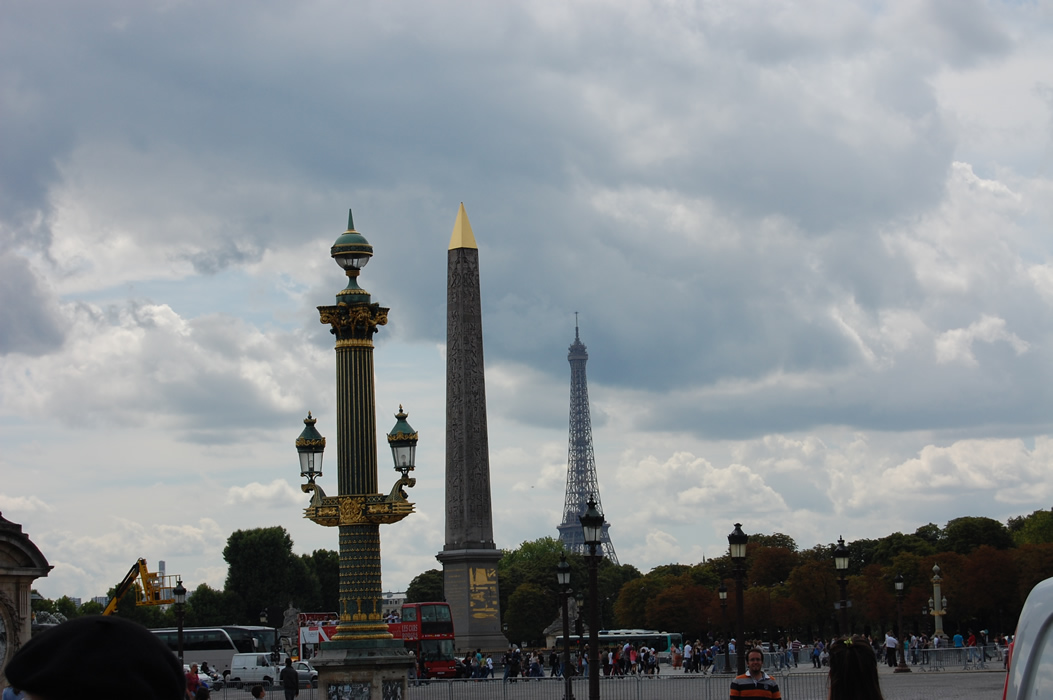
Anyway, getting out to the Jardin in the sun was something of a relief.  We also visited the Grande Galerie de l'Évolution (mamzing, and somewhat vertiginous), and had bread and cheese sitting in the park, before heading to the Place de la Concorde.
The main point of which was that - while half of the family sat outside in the Tuileries - I got a chance to have a wander in the Orangerie...
 I really adore the Waterlillies - but the camera just doesn't do justice to them.